Showing posts with label Commodities. Show all posts

Wednesday, September 28, 2011

World markets are discounting that something big will happen

===================
For my latest musings - please visit www.scottreeve.com
===================


This is my take on the world economy - Preserve your wealth while you still can!

The current talk is that the US and Europe may go back into recession. The reality is that they never left recession that hit in 2008. Bogus diluted statistics, such as inflation, unemployment rates have falsely portrayed the economic reality being felt by individuals in towns and cities around the world. Arguably many cities have been in depression for the last decade (look at Detroit and parts of Europe). The world economy is now on a detox diet and it will take many years, if not decades, to clean it up.

The markets are currently discounting that something very, very big is soon to happen. The markets always do this long before the average man on the street and the media realise it.

It could be a combination of things:
*country default;
* Euro monetary changes (Greece is insolvent, and other countries are close behind);
* central bank quantitative easing (monetising debt);
* major bank failure (particularly in Europe); and
* a significant slowdown in China.

All of these things are very real and we are already seeing the effects of this on world markets.


European contagion

All the major Euro countries are so intertwined lending billions to each other. A contagion will quickly spread when more of the bad debts rise to the surface.

Most of the current Euro-cris discussion is centred around Greece. By many measures its economy looks quite sick. It's sharemarket is now at its lowest level in 18 years (This is debt implosion!).

On other measures it certainly doesn't look as bad as other countries. Greece doesn't have the largest amount of government or private debts in the world, or the highest debt-to-GDP. One big difference is that it owes a much higher per cent of its debt to foreign creditors (foreign banks and countries).

Many argue that its non-sovereign entities which are clamping down on Greece. ie. the Global banking cartel led by the IMF, the World Bank, the Federal Reserve etc working in tune with the credit rating agencies (Moodys, S&P, Fitch). All I ask is what is the interests of the global banking groups? All actions to date show that they put their interests and survival ahead of everyone else. They do not care about the sovereignty of nation states.

So which countries banks' have the most at stake with Greece?

The following interactive chart I put together uses Bank for International Settlements data demonstrating which countries banks are most exposed to sovereign Greek debt as of the first quarter ending March 31 2011.

The most exposured banks are (by country):
French banks US$56.9 bn;
German banks US$23.8 bn;
UK banks US$14.7 bn;

The most exposed individual banks are:
BNP Paribas with US$7.1 bn (France)
Dexia with US$4.8 (Belgium)
Société Généralewith US$3.8 (France)

This is just the banks. When you add Government's holding Greek debt the amount is another US$145 bn.

Chart : There has been a huge widening of bony yield spreads and risk insurance on credit default swaps. Greece has gone parabolic. Portugal and Ireland are where Greece was a year ago.

or as Alan Kohler puts it, when the financial crisis hit last time in 2008, it was about liquidity (banks wouldn't lend to one another). This time around its about insolvency. There is plenty of cash around, but the banks might be broke.

Chart:
source: Alan Kohler, ABC News, Sept 2011

The dominoes are lined up

The next graph shows why the banking system is trying to fix Greece before it sets a precedent. You may have heard that Spain and Italy are "too big to fail, too big to bail". Europe bank exposure to Spain and Italy's are 6 to 7 times worse than Greece.

Chart :

The harsh reality is that no industry should be bailed out, including the banks from country to country. The ongoing debt crisis has come about because banks have lended and taken billion dollar bets to keep this unsound monetary system going (which is based on nothing but paper money generated out of nothing).

Monetary systems do blow up - why is the Euro any different?

One article I came across discuses that country default is more common than we are led to believe. There were a number of large defaults in the 1980s and 1990s in emerging countries across the Americas and eastern Europe. Economist Carmen Reinhart states that the list of deadbeat countries included
"current investor favorites like Brazil, which defaulted in 1983, went through a bout of hyperinflation in 1990 and effectively defaulted again, for the same reason, in 2000"

Reinhart and Professor Rogoff show that, on average, nations add 86% to their debt loads within three years of a credit crisis. At the same time, government revenue falls an average of 2% in the second year after the onset of the troubles. The way things are heading Greece and other Euro countries are heading down this path. Debts need to be rolled over...just like...a few snow flakes can lead to an avalanche.

The Stumble Cycle

Sovereign defaults--when a country stops paying its bills--go in waves, often following global financial crises, wars or the boom-bust cycles of commodities. Some countries, like Spain and Austria, mend their ways; others, like Argentina, are repeat offenders.

Chart :

The combination can be fatal for investors holding bonds issued by financially shaky countries like Argentina or Greece, which sell a lot of their debt outside their own borders (as does the U.S.--45% of all publicly held debt). As a nation's finances deteriorate, foreign investors sell their bonds, putting upward pressure on interest rates. That usually sets off a spiral including a deteriorating currency, which, if the bonds are denominated in foreign currencies, makes it impossible for the country to pay its debt. Greece doesn't have to worry about this last syndrome, because it uses the euro. But that might make things worse since it can't print its way out of its financial difficulties. "It's like entering a prize fight with one hand tied behind your back," Bass says. Argentina takes a different tack. Still struggling in the wake of its 2002 default on foreign-held debt, its president recently tried, and failed, to seize central-bank dollar deposits (and cashier her central banker) in order to repay overseas debt.


France

Following from earlier discussion, the big questions are which of the big European banks will go under first. The largest French banks, Credit Agricole and Societe Generale have billions in exposure to Greece and other Euro countries.

Chart : The share prices of the 3 largest French banks have fallen 73%, 87% and 87% since start the debt crisis started in 2008.


Italy

Until recently UniCredit was the largest bank in Italy by market capitalisation and a major euro-zone bank. It owns other large banks in Germany, Austria, and Poland with around 40 million customers all up. As the following charts shows, the market is dumping the two largest Italian banks. UniCredit is one of the "too big to fail and bail" euro banks and many of its depositors lie outside Italy, making and bail out practically impossible.

An ironic twist to this is that, UniCredit's predecessor was a bank called
Credit-Anstalt. This bank collapsed in 1931 which lead to a contagion which took Europe off the gold standard and pro-longed the Great Depression. Few people remain from the last depression era. Perhaps the money lessons need to be relearn?

Chart :


Australian dollar

The Australian dollar is a proxy for commodity prices and ultimately China. The Australian dollar has recently fallen sharply to 97 cents and has hit a major support level. If this fails there is another major support level at 94 cents.

Chart: The Australian dollar managed to bounce off the firs support level at US$0.97


Commodities

Overall commodity prices are not showing that China is in immediate trouble. Base metals: copper, zinc, nickel, lead etc are not in a major bear market yet. This may mean that the current correction will be short lived. If base metals start free falling and other negative signs come from China (popping of housing bubble?), than the Australian dollar and commodity prices will fall a lot (a huge amount) further.

Gold

Meanwhile, gold and silver have recently experienced a significant correction. Chart wise (USD/gold), gold's correction is not unhealthy. Gold was sitting at 11 year bull-market resistance line and its trending support line is about US$1550.

Chart:


As I posted recently, I believe the gold demand is getting stronger, and will remain strong, despite the recent price volatility. Since that post it has been reported that Mexico, Russia, South Korea and Thailand have all made large purchases in 2011 and globally, central banks are set to buy more gold this year than at any time since the collapse of the Bretton Woods system 40 years ago. The IMF even reported that European Central banks have started accumulating small quantities of gold after selling on average 400 tonnes of gold a year since 1999.

Silver

Silver plummeted last week by 34 per cent within trading days. It went straight through two key support levels and bounced back above them. After hitting a low of US$26.03, silver rebounded 28 per cent in 28 hours.

Chart: Silver fell 34 percent within 4 trading days, then bounced 28 percent within 28 hours


Is this volatility unusual? Silver is a very small market and historically has been prone to major corrections. My research shows that the major corrections in the last few years has lead to an increase in demand for physical silver (from mints and bullion dealers). I believe this will happen again.

Australia

Take away mining and Australia is in recession, and as I stated early, the key to the Australian economy is whether China can keep its economy upright. If it shows signs of weakness, commodity prices will collapse (along with oil, gold and silver) and the Australian Dollar will fall 10 or 20 cents against the USD.

China kept the world economy somewhat afloat during the global financial crisis, and is the sole reason why Australia didn't go and stay into a technical recession. One of the key barometers on the health of China is commodity prices.

Tourism has been in recession for many years now, in part to the high Australian dollar and a tightening of consumer belts.

Manufacturing has largely been in recession for a number of years except for businesses with astute management and niche business models.

Manufacturing insolvencies growing

Despite insolvencies around the world dropping to their lowest levels in nearly four years, Australia is headed in the opposite direction. This year is shaping up to be a record one for business failures on a par with troubled Eurozone countries. The most recent D&B Global Insolvency Index, ranking business failures in more than 30 key economies, found Australia's insolvency rate was on a par with indebted countries such as Italy, Spain and Hungary. Australia recorded a 12.1 per cent increase in business failures in the June quarter compared with falls elsewhere in the world of 5.7 per cent. D&B said its findings tied in with Australian Securities and Investments Commission data which pegged 2011 as a record year for insolvencies.

Business failures in manufacturing have soared 60 per cent in three years. Almost 300 manufacturing firms went broke in the first six months of this year, the business analyst Dun & Bradstreet says, and just 14 new manufacturers started up. By contrast, in 2008, 974 new manufacturers got off the ground, and only 392 folded.

Retail

Retail is finally entering recession. This has long been coming, even though the likes of Westfield (and other groups) have been creating mega-shopping centres around Australia. The whole retail industry relies on ever increasing amounts of debt (more credit cards and increasing consumption). This model is dead, and there is currently too much competition in Australia alone (before you look at internet shopping of overseas products on eBay and the like). Take electronics, there are so many major stores competing on price, and margins are getting thinner. Many of the private equity firms which bought up a lot of the retailers in recent years have failed, as over-inflated sales targets have missed the mark. In the last 12 months several major groups have entered administration: REDGroup (Borders/Angus and Robertson bookstores); Colorado Group (Jag, and shoe shops), Allied Brands (Baskin Robbins, Cookie Man), Krispy Kreme doughnuts, and Starbucks Australia. Most recently sharper falls in consumer spending has forced Harvey Normany to scrap its Clive Peeters and Rick Hart brands (7 stores to close) and David Jones announcing a 10.3% drop in fourth quarter sales and now expects a small profit for the new financial year.

Sizeable retrenchments are coming.


Housing

Chart:


Lastly, this is a very good presentation by Mike Maloney


Cheers
~ Scott

Saturday, November 20, 2010

Who will save China?

In few months its become apparent that more and more reporters are jumping on the “China is vulnerable after all” bandwagon. I have had this view for some time now, and this post will examine a few reasons why China is as-vulnerable as many other countries in the world. Australia is very vulnerable because we are so reliant on China and commodity prices.

The Chinese Miracle?

The growth of China's economy in the last 15 years is nothing short of a "miracle". Compared to the other miracle economies, the 4 Asian tiger economies up to the 1990s and more recently the Celtic Tiger (Ireland - the roaring tiger of Europe - look where it is today!), China is in a completely new ball park. No country in history has built so much stuff in such a short space of time. World production of materials is mind-boggling. China can do it all, and in turn is de-industrialising higher-cost manufacturing in the western world. Demand for iron ore, coal, copper right down to steel and concrete has exploded. But can China perpetually build more and more steel mills and skyscrapers?

Well, no...

China is vulnerable to economic depression. The common denominator in every country is that all the banks operate under insolvent conditions, its just that the citizens rarely force a bank run to prove this Achilles’ heel. The main point here is, the common base line in every country today is the type of “money” used. The US Dollar, Australian Dollar, Chinese Renminbi and the Zimbabwe Dollar are all fiat currencies. Whilst there are significant differences in value of these currencies (or rather the rate of devaluation/loss of purchasing power), all currencies around today are still “fiat”, that is, money which is declared by Government to be legal tender and without intrinsic value (no gold backing). Through fractional reserve banking ("Money creation") and printing new money into existence the rate of economic growth in any country can be very rapid for a number of years. However, all good parties end in one big hangover. China's hangover is coming (particularly if they do not prepare for post US-Dollar monetary system).

Now that we have apparently coming through the worst of the so called Global Financial Crisis (GFC), every second economist on the street has hailed China as the world’s savour, and indeed in Australia, the Deputy Governor of the Reserve Bank of Australia RBA), Ric Battellino, believes the commodities boom could last for another 15 years – all of course, thanks to emerging economies of China and India.

Whilst I agree that China has helped the world during the GFC, and that we will continue to be in a long-term commodity boom, my reasons are completely different. And here is why:

• Chinese Banks inflated the world out of the 2007-2009 Global Financial Crisis
• The Commodity Boom over the next 10 years will be extremely volatile

Chinese Banks on steroids…

Answers to the future often lie in history. China invented paper money way back in the 10th Century AD. Every single paper-fiat currency created since (except for those existing today) have collapsed to a net worth of zero. Fiat currencies will always come and go because Government's cannot resist the temptation to use inflation to pay for election promises (or to help keep opposition parties out of government..). China, and every other country will not be able to defy economic reality with fiat currency this time around either. Keynesian economics will hopefully follow soon after.

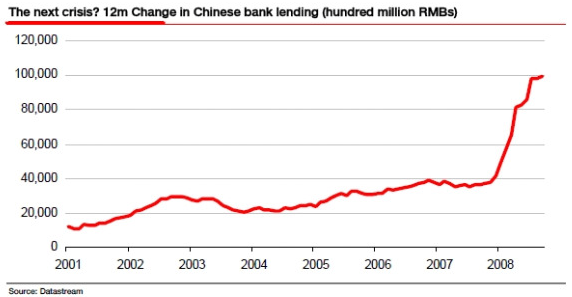
As the following two graphs demonstrate, it’s the major global bank’s that fuelled the sub-prime bubble (in the US) which led to the GFC, and then subsequently it was Chinese stimulus spending and bank lending which helped the world get through the worst of the GFC. China just filled the void to get the world through the first phase of economic depression. This banking bubble is completely unprecedented. There is still many decades of debt still in the system - which is yet to be paid (accounted) for.

Chart 1: Global banking bubble
source: ABC News

Chart 2: Chinese banking bubble... but who will save the Chinese banks!?

The RMB¥ 4 trillion (US$ 586 billion) Chinese economic stimulus plan announced by the Chinese central government was all aimed at getting Chinese companies to build more Chinese goods and buildings. As I will explain a little bit on, China was already building at a very fast and unsustainable rate. This stimulus inevitably brought forward work and is now creating double digit inflation to their economy. Increasing credit always delays and make bubbles worse.

As consumer confidence was low in the US, and China, Japan and Asia were unable to keep exporting products to the US consumer, China took up the slack and increased bank lending dramatically, converting their economy from being strongly export-oriented (to the US) to fuelling domestic demand through stimulus. The Chinese Economic Stimulus Plan was used to offset the sub-prime housing crisis in the US to counter-act it with a Chinese property bubble. In essence, creating a new bubble market to replace a busting bubble market. The end result, I strongly believe, will have dire consequences to China, and Australia and the rest of the world. Like holding out a red flag to a charging bull, China will soon get caught out.

For now the commodity boom will continue, but… the next 10 years will be characterised by extreme volatile periods of double digit annual growth to significant periods of price deflation. Ultimately, gold, silver and soft commodities (food) will be sought after on-mass. People will change their spending habits to have economic security.


Construction, construction, construction!

Construction now makes up 60% of China's GDP. This compares to single digit GDP for China's total exports. China is building and manufacturing absolutely everything for the world, ten times over (or more?)

James Chanos:
No country has ever had done more than 9 years above 33% of GDP (in fixed assets – construction). China is now on its 12th or 13th year.


You gotta be in property! (especially if you are a central government)

In August this year the Financial Review ran an interesting article (lost on page 60) on China's central government trying to cool its property bubble. The article reported that all sorts of random companies were delving into property, from salt companies to railway companies. It goes on...
All around the nation, giant state-owned oil, chemical, military, telecom and high groups are bidding up prices on sprawling plots of land for big real estate projects unrelated to their core business. ...

By driving up property prices, the state-owned companies are working at cross-purposes to the central government's efforts to keep China's real estate boom from becoming a debt-driven speculative bubble.

Records show 82 per cent of land auctions in Beijing this year were won by big state-owned companies outbidding private developers - from 59 per cent in 2008.

Further:
land prices in Beijing had lept 750 per cent since 2003, and that half of tha gain had come in the past two years. Housing prices have also sky-rocketed, doubling in many cities over the past few years.

And as the prices of new apartments soar - in Shanghai, for instance, they often exceed $US 200,000, while the average disposable income isa bout $US 4,000 a year.

The article also made reference to the status of the state-owned banks. They they:
- had made $US 1.4 trillion in loans, nearly twice as much as the year before
- were making off-balance sheet manoeuvres
- were likely sitting on enormous unreported debt

Lastly, the article argues that different levels of government were behind the push in real estate because it was so "incredibly lucrative". Many municipalities have formed local investment vehicles that borrow from state-owned banks to pay to relocate citizens to build on their land, so the government can then auction off the new properties for profit.

Does this all sound like Sub Prime Mortgages on steroids times by a factor of 10?

Housing Affordability in China
One clear clue (regarding the rising real estate prices in China) is that the average price-to-income ratio in Beijing has reached 27:1, five times the world average, according to data from the Bureau of Statistics of the Beijing Municipality. In addition, the average price-to-rent ratio neared 500:1 in the city, far above the international alarm threshold of 300:1, which sends out a clear signal that the foundation of the real estate boom is losing stability.


Steel production up 6 fold in 10 years

To further put this into perspective, all this construction material had to come from somewhere. Of course, in Australia we know about the China boom and our record iron ore and coking coal sales have led to our highest terms of trade since the early 1950s.

Australia has helped fuel the great Chinese construction bubble. In 1999, the Chinese steel industry produced some 124 million tonnes of crude steel. This was a similar size to Japan and the United States. For comparison, in the same year Australia produced about 8 million tonnes. The following two charts illustrate the magnitude of China's construction mania.

Chart 3: China produced 16% of total world steel in 1999
source: World Steel Assoc. (public data)

Chart 4: 10 years later China now produces more than 46% of total world steel output
source: World Steel Assoc. (public data)

China’s steel production has gone up almost 6 fold in the last decade. To put this in perspective Australia’s steel production is now about 1% of China’s (or 0.5% of world) total annual steel production. ie. China produces Australia’s total annual steel production in just 5 days! China is now making more steel than what the entire world produced in around 1990.

To analyse this from another perspective, there are more stories in the media in recent years of ghost cities and empty mega malls springing up in parts of China.

Video: Fuelling the next housing crisis – this time in China

China also has the world’s largest shopping mall, the New South China Mall (based on leasable area) remains 99% vacant since opening in 2005. (video now unavailable)


Centrally planned economies do not work

Centrally planned economies have never worked over the longer term. I am not debating the nitty gritty of what the difference between communism vs. capitalism is, at the end of the day, the more intervention by Government’s and, particularly, central banks, the more mis-allocation of labour and capital there will be. The end result is massive overcapacity and ultimately price suppression (monopolistic behaviour on other countries). China is an extreme case at point, where the central government right down to municipal governments have had competing interests to increase employment at all costs. The municipal/provincial governments have also been competing for trophy industries, they all want to be the biggest and best at manufacturing, particularly steel and automobile industries. Exponential growth in credit, employment, and government intervention in markets eventually comes to an abrupt halt.

Far from what many economic commentators in Australia preach day in day out, that China is Australia’s economic savour amongst the global uncertainty in Europe and the US. To the contrary, I believe our over-reliance on China will ultimately bring harsh repercussions for Australia. On one side, China and the US will kill off the commodity boom. The biggest mining boom in history, inevitably will end in the biggest mining bust. The expansion plans of BHP Billiton, Rio Tinto, Fortescue Metals (among others) will result in major overcapacity, and empty ports. A huge call, perhaps crazy in today's climate, but this endless expansion will not keep going. Many of the major projects will be mothballed. Marginal projects will once again be marginal and left on ice for easy money to come around again.

James Chanos sums up the current situation rather nicely. James is best known for seeing the problems of Enron and shorting its stock up until its collapse. He recently warned that China's hyper-stimulated economy is headed for a crash, led by its housing bubble.
Its become very apparent... that China has embraced capitalism to keep the socialist elites entrenched, while more lately in the West we have embraced socialism to keep the capitalist elites entrenched. It’s a little bit of the opposite side of the same coin.

** Note ** I am soon to launch a new website at www.scottreeve.com, which will incorporate this blog and other areas of interest ~ Cheers, Scott

Friday, October 31, 2008

Global Trade at Risk

The following is an article today from Alan Kohler. He and a few other commentators were talking about this issue a couple of weeks ago. It appears to have worsen significantly, and yet it doesn't even pop up on the nightly news or the front of main stream newspapers.

Kohler's articles can be viewed daily at: http://www.businessspectator.com.au


The global shipping crash continues to get worse and this morning’s GDP data shows the US recession is already deeper than 2001 and probably 1990-91 as well.

Meanwhile the International Monetary Fund seems determined to make the whole thing worse by imposing the most ruinous strictures on supplicant nations.

Yesterday the Baltic Dry freight rate index fell below 1000 for the first time in six years and last night it fell another 40 points to 885. In June the index was 11,900, so it has fallen 93 per cent in a few months – a crash far worse than anything ever seen in the stockmarket.

The spot daily rental for a Capesize ship is now $6365, down from $234,000 per day over the space of a few weeks. Maybe that previous price was absurdly inflated, but at $6365 it is just $365 above the average daily cost of crews and fuel.

As a result the world’s ports are filling with empty ships because shipowners can’t afford to run them, as well as some full ships because the owners of the cargo won’t unload without a bank letter of credit, which banks are refusing to supply.

Shipping companies are starting to file for bankruptcy in increasing numbers as they breach loan covenants, and a shipping researcher, Andreas Vergottis of Tufton Oceanic has told Bloomberg that a fifth of the world’s dry bulk companies may soon have negative net worth because the market for second hand ships has collapsed and the value of their fleets is below outstanding debt.

Like property-based loan agreements, shipping companies’ debt covenants have loan to value ratios that are typically 70 per cent. As the value of their fleets decline, banks are making margin calls.

Meanwhile, as expected, US GDP fell in the September quarter – by 0.3 per cent. The only reason it wasn’t worse was government spending, which added 1.1 per cent to the rate of GDP change. There was another 0.6 per cent from private inventories – that is, unsold goods.

In any case, US economic data is always rushed out quickly, based on guesswork, and then revised later. Most of the guesses in this morning’s figure look optimistic, so it is very likely to be revised downwards.

Even on this morning’s optimistic estimate, it is the first year-on-year decline in GDP since 1991, so this recession is already worse than 2001 and clearly has a long way to go.

And remember that in 1990-91 – and 1980 and 1973 and 1961 for that matter – the monetary and fiscal authorities were more or less in control. Or rather – they started it.

Those recessions were caused by central bank and government efforts to control inflation. This time it’s all about a spontaneous collapse in private sector credit and governments around the world are desperately trying to counteract its effects with interest rate cuts, liquidity injections and fiscal stimulus.

That is…all except the IMF. It is imposing the most horrendous conditions on bailout loans to bankrupt countries.

As the rest of the world’s official interest rates come down, Iceland’s this week went up 6 per cent, from 12 to 18 per cent, as a condition of its $US2 billion rescue package.

Hungary, Serbia, Belarus, Pakistan and Ukraine are now facing the most excruciating choice: default on their debts or ask the IMF for money at the expense of crushing their economies under the weight of a massive increase in interest rates.

As Ambrose Evans-Pritchard writes in last night's London Telegraph: “A deflationary strategy of this kind could prove counterproductive – or worse – if applied in enough countries simultaneously. It would defeat a key purpose of the rescues, which is to stabilise the global financial system.”

Meanwhile China, the world’s greatest creditor nation, is now cutting interest rates as its economy slows.

The emerging world in general has “recoupled” (if it was ever decoupled) and the removal of hedge fund investments in their currencies, government debt and sharemarkets will, in many cases, result in deeper recessions in those countries that in the US – where it all started.

Which is why global shipping has collapsed
: it is the harbinger of the end of the era of trade, in which third-world labour costs kept first world inflation down and allowed interest rates to fall and stay low and debt to be increased to an historic degree.

That process of importing deflation (or, more precisely, disinflation) from developing nations – especially China and India – relied on trade: raw materials in; finished goods out.

The fall in freight rates for both dry bulk carriers and container ships is telling us that it’s over.


Australia is potentially in the most vulnerable position. Commodities could potentially be on the brink of collapse if ships do not start to move soon. Already we are currently witnessing Mount Gibson Iron (MGX.ax) in a trading suspension because China will not/cannot move its ships to buy MGX's iron ore. MGX is by no means a small Australian company. It is in the ASX100, and would be in the top 20 resource companies in Australia.

The fallout of a huge resources bust is almost unthinkable. A few zinc mines have shut (or reduced output) over the last few months in Australia. Now at current spot prices, even OZ Minerals Century Mine (formally Zinifex) near Mt Isa, the 2nd largest zinc mine in the world, is unprofitable at current prices. Commodity prices need to rebound quickly along with ship movements, or Australia will enter deep recession within a year. Commodities make up around 60% of Australia's exports, and it is no coincidence that the Australian Dollar has fallen by 40% in only a couple of months!

Picture this: A truck driver working in a mine in the Pilbara earning over A$100,000 p.a. suddenly looses his job because the mine shuts down. Only a year earlier he took out a mortgage on a new house in Perth. However, 100,000s of other people are in the same situation. Mines closing, exports decreasing. Australia hits recession and there are few jobs. The miner, who expected to maintain employment and a high income is suddenly unable to pay the monthly mortgage with no solid income. Property prices across Australia then start falling sharply on weak buyer demand and falling expectations.

This is a real possible situation which may hit Australia soon if the resources boom comes to a grinding halt which is increasingly looking more likely.

Scott

Tuesday, October 14, 2008

Boiling Frog Syndrome

Boiling Frog Syndrome

Ted Butler of www.investmentrarities.com summed the current situation up best.

People do not appreciate the current economic events, because every day there is more and more bad news. We start to tune out of it after a couple of banks go under. It starts to feel normal (or common). People also just do not like to hear bad news. It's a bit like hearing terrible war stories from Iraq or Afghanistan. We do no truly appreciate the true seriousness of events over time, only if it personally affects us.

If you put a frog into a pot of cold water and increase the heat gradually to a boil, he won’t jump out.

The heat is on the world economy and now is the time to wake up. Don't wait for the water to reach boiling point. Major banks and insurance companies which go back to the mid 1800s do not suddenly go bankrupt for no good reason.

(Ted's boiling frog explanation was originally in relation to a retail shortage in the silver market. I have yet to find time to discuss the opportunity in silver on my blog, but right now there is a 10 week wait to take delivery of any silver in Australia. There is a worldwide shortage, yet the price of silver is still low because of market manipulation by a couple of US Banks. More to come on this subject..)

To avoid the boiling frog syndrome you must have i) an open mind, ii) change your context and iii) take action.


Last week in Review:

U.K. Trillion Dollar Bailout


Last Wednesday 8 October 2008, the UK government announced a £400bn bank rescue package to help increase bank capital and sure up loan guarantees.

The chart below puts some perspective on the bailout plan:

Six central banks cut rates

Also on Wednesday, six central banks cut interest rates by half a percentage point (following Australia 1.0 percentage cut on Tuesday). The US official interest rates are now 1.5%, and the European Central Bank (ECB) has its rate at 3.75%.

"Free-Fall" Friday

Sharemarkets continued to fall dramatically last week, with many stock exchanging closing at one point due to indexes falling by over 10% (Indonesia and Japan). The worst falls by far came on Friday.

- Australian ASX down 8.2% (down 16.2% for the week!)
- Japan's NIKKEI down 9.62%
- UK FTSE down 8.85%
- German DAX down 7%
- US Dow Jones down almost 10% at start of trade, but ended up closing 1.5% lower.

The Australian Sharemarket has now fallen 42.5 percent since its peak on 1 November 2007 in about 243 days. This bear market is officially worse then most previous bear markets.

Prime Minister Rudd Guarantees bank Deposits

Political pressure came to be, with the Australian Prime Minister would guarantee all bank deposits in Australia for the next 3 years. This is estimated to cover about A$700 billion. The government also doubled to $8 billion the funds available to improve liquidity in residential mortgage-backed securities.


Main discussion point today: Shake up for world Industries

Automotive

The US car industry, in particular, has been in dire straits for a number of years. The only reason General Motors (GM) and Ford have not gone into insolvency is because the US Congress keeps throwing tens of billions of dollars at them. A couple of weeks ago $24 billion was thrown.

The US Government is not prepared to see GM and Ford collapse. They are bigger then many countries in terms of annual revenue and employment.

Ford currently has a market cap of US$4.55 billion. Ford lost US$12.6 billion in 2006, and US$2.7 billion in 2007. In the 2nd Qtr 2008 it lost $8.7 billion! (in only 3 months).

GMs share price is now at the levels of 1956, with a market capitalisation of US$2.77 billion. GM lost US$38.7 billion in 2007, and US$15.5 billion in the 2nd Qtr 2008! (in only 3 months).

Companies which are loosing tens of billions of dollars every year should not be kept in business. New car sales in the United States are now at their lowest level in 15 years. The US Government and taxpayers have always subsidised the auto industry, but the cost of doing so today is for its very survival. If they were allowed to fail, many hundreds of thousands of workers would loose their jobs world wide (think of component manufacturers and indirect jobs). I suspect the main reason for keeping GM and Ford alive is all about confidence. In the early 1930s, Ford laid off 10,000s of workers, which helped fuel further unease in the outlook for US economy.

They represent manufacturing and economic activity. With millions of American's foreclosing on their homes over the last few years, no one is looking for a new car. People go back to basics and if the 2nd hand car works, why replace it?

Talk on the street is that Ford and GM proposed a merger recently. Current talk is GM is now exploring a merger with Chrysler and Ford is apparently seeking to offload its majority stake in Mazda.

Where ever this goes next, one thing is almost certain and that is consolidation in the automotive sector. There has been too much competition. The car manufacturers have been absorbing rising steel prices, aluminium prices, wage prices etc. As a consequence, they have been unable to pass these costs onto the consumer in full and their profit margins are squeezed. So they have been left caught building increasingly expensive cars, that no one is prepared to buy.

Consolidation across other industries


There will be more consolidation across all other areas of industry. The longer the credit squeeze goes on, the more depsrite companies will be to merge with one another, or face bankruptcy. Right now it is basically impossible for companies to raise equity, to raise debt, or even sell assets to raise cash.

Airlines

The best example of consolidation will be in the Airline industry. We are all familiar with the $1 special sale fare's JetStar and Tiger Airways etc has every few months. Competition is fierce, yet airlines are operating in an environment where fuel has been hurting growth and profits. Air Italia is going under. The low-cost carrier model isn't sustainable. Only the major airlines which consolidate will survive a major global downturn. Many have gone under in the last few years, and this happened in economic good times.

Commodities:

As discussed previously, commodities have had a rough time in the last couple of weeks. Deflation is hitting both hard commodities (metals and energy) and soft commodities (agriculture).

Hard Commodities

In Australia, we should particularly see consolidation in the resources sector. Many high-cost producers and explorers will go out of business. Companies will need to preserve capital, which means less exploration. Those who have plans to start producing 3 or 5 years down the road will find it difficult to get into production. The best near development assets will have to team up (joint ventures) with cashed-up majors or sell equity to overseas investors to get their project into first production. Only the very low cost producers will manage to bring in sustainable cashflows to keep their business going.

Right now the market is factoring in that many resource companies will fail. However, some of the better companies are falling just as hard as the bad ones. Several companies I have come across have a market capitalisation less then the cash they have in the bank (AED, BRM and CFE for example). Maybe the market is factoring in that the Australian Dollar will be worth less in the future :) ?

It was only less than 10 years ago, that many large resource companies went insolvent and closed down their mines. Zinifex (now OZ Minerals) is essentially a repackaged Pasminco. Ironically now that zinc and lead prices are becoming low again, and many mines are being closed and placed on care and maintenance.

Commodities work on boom and bust. This sector works on over confidence or no confidence. You don't want to be holding a commodity stock during a bust. Right now the market is factoring in that the US led global slow down will severely affect demand coming out of China.

Soft Commodities

Soft commodities should fare much better then hard commodities in times of economic depression. Our spending habits change from buying luxury goods (new cars, plasma's etc) to the very basics. At the end of the day people still need to eat, and if it takes 100% of our disposable income to buy food, people will do it (which is exactly what has been happening already in some countries).

However, the global liquidity freeze will affect farmer's world wide. Banks will be less willing to lend debt to farmers for a wide variety of reasons. Many farmers are already in heavy debt, and have less capacity to repay debt in the future. There is always the uncertainty of drought, flood and other forms of crop failure. Farmers have also been absorbing a large slice of the inflation pie in recent years. Rising fertiliser and fuel costs have not been offset by rising food prices. Farmers are still price takers, with many receiving the same prices for potatoes or milk then what they did 10 years ago. They know exactly what inflation is (on costs of production), and they know exactly what deflation is (the price they receive). On top of this, the 2 major supermarkets in Australia are squeezing the farmers (and food manufacturers) out of the market because of their market power. Lastly, rural Australia is already being hit hard by an aging population. There are not enough young people coming through to replace those looking for retirement in the next 10 years. All this factors will mean there will be fewer farmers, less domestically grown food, higher prices, and more food imports to Australia. Couple this with international factors, such as a population the size of Australia moving from rural to urban landscapes in China each year, and a major push for biofuels, and its easy to comprehend that food prices world wide will inflate dramatically in the coming decade.

Investing in a backyard vegie garden might become widely popular again, or be prepared to pay a greater amount of your disposable income on the basics.


The next post will be on Household Debt and why Australia may end up in a worse situation than the US within the next couple of years.

- Scott