Showing posts with label China. Show all posts

Tuesday, July 12, 2011

Major developments in the gold market

Precious metals demand is soaring worldwide, as the global debt crisis continues…

Timeline of articles below:
=============================
4 May 2011 – Mexican central bank buys 100 tonnes of gold
20 May 2011 - China becomes world largest gold investment market
6 June 2011 – The Federal Reserve admits it does not own any gold
16 June 2011 – Congressman Ron Paul calls for audit of Fort Knox gold
18 June 2011 - Russia warns it will continue to sell US debt
20 June 2011 - India’s May 2011 precious metal imports up 222 per cent on May 2010
20 June 2011 – China’s central bank to mint more gold and silver coins
22 June 2011 - Greek savers rush for gold
7 July 2011 - Swiss Parliament to discuss gold franc
=============================

plus:
Dow-gold ratio, US home-gold ratio, and interesting videos later in this post.


4 May 2011 – Mexican central bank buys 100 tonnes of gold

FT.com reports:
Mexico has quietly purchased nearly 100 tonnes of gold bullion, as central banks embark on their biggest bullion buying spree in 40 years.
The purchase, reported in monthly data published by Mexico’s central bank, is the latest in a series of large gold buys by emerging market economies intent on diversifying reserves away from the faltering US dollar.
China, Russia and India have acquired large amounts of gold in recent years, while Thailand, Sri Lanka and Bolivia have made smaller purchases.
Central banks became net buyers of gold last year after two decades of heavy selling.
As a result of Mexico’s purchase, central banks, sovereign wealth funds and other so-called “official sector” buyers are on track to record their largest collective purchase of gold since the collapse of the Bretton Woods system, which pegged the value of the dollar to gold, in 1971.
Mexico bought 93.3 tonnes of gold in February and March, according to the central bank, in a haul valued at $4.5bn at current prices and equivalent to 3.5 per cent of annual mined output.

20 May 2011 - China becomes world largest gold investment market

In 2007, China overtook South Africa to become the world’s largest gold mining nation, however it continued to lag India in overall gold demand. Despite producing 351 metric tons of gold in 2010, China’s gold demand last year hit 700 tons.

On 20 May 2011, the World Gold Council said in a quarterly report that Chinese buyers overtook Indians as the world’s largest purchasers of gold for the first three months of this year.

China's investment demand for gold more than doubled to 90.9 metric tons (mt) in the first three months of the year, outpacing India's modest rise to 85.6 metric tons. China now accounts for 25% of gold investment demand, compared with India's 23%.
The report underscores the rising appetite for gold among the growing middle-class in China. Fears of the country's soaring inflation, as well as a search for new investments, is luring investors to gold, and marketing of the precious metal has also increased in recent months.
Historically, India has been the largest investment market for gold. In 2007, just before investing in gold began to take off globally, India's physical gold demand accounted for 61% of the world's total. China's was 9%. In terms of total consumer demand, which also included jewelry, India is still a bigger consumer of gold than China, taking in 291.8 tons in the first quarter, compared with China's 233.8 tons.
Aside from having more money, Chinese investors are also focused on using gold as a protection against rising consumer prices. Unlike paper currencies, gold retains its value when prices increase. That has prompted many Chinese investors to flock to the precious metal.
Gold also is favored by savvy investors as an alternative investment vehicle to assets like shares and real estate. Chinese stock markets have been a disappointment recently, and the government has pledged to clamp down on housing speculation.
The report covers only private-sector demand, but one wild card for the world's gold market is how much gold China as been adding to its foreign reserves. Governments tend to announce their purchases after they buy.

To put this into another angle...

The not realised important fact that the people of China were banned from owning gold bullion from 1950 to 2003, means that the per capita consumption of over 1.3 billion people is rising from a tiny base.


6 June 2011 – The Federal Reserve admits it does not own any gold

Goldsilver.com reports

Video:


Thats right. The Fed owns NO gold. Zero, zip, ziltch.
For those of you who did not watch yesterday’s monetary policy hearing in the house of representatives, you most likely missed this bombshell exchange between Federal Reserve lawyer Scott Alvarez and committee chairman Dr. Ron Paul. My jaw literally dropped when I heard the Fed’s general counsel declare that the Federal Reserve owns no gold. After 1934, Alvarez explains that the Fed handed its gold over to the Treasury in exchange for gold certificates. When pressed further, Alvarez noted that the gold certificates do not represent any interest whatsoever in the gold itself. He explained the gold certificate listings on the Fed balance sheet, not as a claim to gold, but at most a claim to dollars from the Treasury. See the quotes here (and watch the videos at the bottom of the post):
Scott Alvarez: “The Federal Reserve does not own any gold at all… we have not owned gold since 1934, um, so we have not engaged in any gold swap. Before 1934 the Federal Reserve did, we did own gold. We turned that over by law to the Treasury and received in return for that gold certificates.”
Ron Paul: “…You have the securities for essentially all the gold?”

Scott Alvarez: “No. No we have no interest in the gold that is owned by the Treasury. We have simply an accounting document that is called gold certificates that represents the value at a statutory rate that we gave to the Treasury in 1934″

In any case, we can analyze the implications of the basic facts and come to a couple of conclusions:
1) The widespread notion that the Fed owns gold is false. The corollary to this is the mistaken belief that the Fed understates its gold holdings on its balance sheet by only reporting certificates based on the $42.22 statutory gold value. The Fed does not in fact own the US gold stock multiplied by the market price of gold, unless the Treasury defaults and even then its not clear. The Fed does, however, own a claim to currency totaling $11.1 billion and this value has a remote chance of going up significantly if the Treasury revalues its gold and maintains the practice initiated in the Par Value Modification Act.

2) The fact that the Fed owns no gold, nor claims to any gold, means the fundamental value of the dollar lacks any backing besides dollars themselves, not including Fed building and equipment. Dollars are in essence worth a lot less than many people thought, and the Fed is much more impotent in using the prowess of their assets, and conducting monetary policy in general, than many believed. In all, Alvarez’s clarification strengthens the case for gold’s high dollar value immensely.


16 June 2011 – Congressman Ron Paul calls for audit of Fort Knox gold

Businessweek.com reports
Ron Paul, the quixotic congressman and three-time Presidential candidate, has won a following among libertarians and government skeptics for his campaign to abolish the Federal Reserve. Now the Texas Republican has embarked on a new monetary mission: He wants to throw open the doors to Fort Knox.
Paul isn't so sure the nation's supply of gold is all accounted for and thinks it might not exist at all. He has introduced legislation that would require an independent count of the 5,000-plus tons of gold bullion that's sacked away in the Kentucky vault, as well as smaller amounts held in government facilities in Denver, West Point, and New York City. Paul also wants a lab to test the bars, to prove it's as pure as the U.S. Treasury Dept. says.
As chairman of a House Financial Services subcommittee that oversees the gold stores, Paul called a hearing on the matter for June 23. One man who's looking forward to refuting the congressman's doubts: the person in Washington who has actually held those gleaming, 27-pound gold bars in his own hands. Eric M. Thorson, the inspector general of the Treasury, is responsible for keeping track of the U.S. Mint's deep storage gold and silver reserves. Last September, he became the first outsider in 37 years to be granted full access to the U.S. Bullion Depository, as Fort Knox is formally known.
Opened in 1937, the vault is encased in 16,000 cubic feet of granite and 4,200 cubic yards of concrete. Until September, even Thorson and his team of auditors had never stood in the presence of all the gold. Their annual reviews mostly consisted of making sure the locked compartments hadn't been opened. At the time, the tamper guards were decidedly 18th century: Each door was secured with special tape and sealing wax. Thorson tried to reassure Paul that the loot is all there.
The congressman's two-page bill, introduced in April, calls on the Treasury to conduct a full audit of the gold. The Government Accountability Office would then review the results. It also orders a full assay of the government's gold reserves. A small portion of each of the approximately 700,000 gold bars would be extracted and tested for purity.


18 June 2011 - After Dumping 30% Of Its Treasury Holdings In Half A Year, Russia warns it will continue to sell US debt
The WSJ reports that "Russia will likely continue lowering its U.S. debt holdings as Washington struggles to contain a budget deficit and bolster a tepid economic recovery, a top aide to President Dmitry Medvedev said Saturday. "The share of our portfolio in U.S. instruments has gone down and probably will go down further," said Arkady Dvorkovich, chief economic aide to the president, told Dow Jones in an interview on the sidelines of the St. Petersburg International Economic Forum."

Russia has now cut 30% of its Treasury holdings in the past 7 months.

Contrast the above chart with the next chart:

The Central Bank of the Russian Federation updated their website showing that during the month of May, Russia purchased 200,000 ounces of gold for their reserves...and currently hold 26.7 million ounces of gold bullion.


20 June 2011 – China’s central bank to mint more gold and silver coins

Mineweb.com reports
According to a report by Chinese news agency Xinhua, China has been sharply increasing its output of gold and silver coins to meet seemingly ever-increasing popular demand for precious metals as people buy to protect against perceived rising inflation. Indeed it has more than doubled the maximum issuance for 2011 for some popular gold coin sizes from its previously announced levels.
China produces gold and silver Panda coins. The Peoples Bank of China (PBOC) has announced that in view of the rising demand for the coins, the number of one ounce gold Pandas will be raised from the previously announced 300,000 units to 500,000 this year. The smaller coins in the series will have their maximum circulation numbers increased from 200,000 coins to 600,000 for each series. This is a huge increase from the previously announced levels for 2011 which in turn were sharply higher than in earlier years.
And showing the big pick up in demand for silver in China, the PBOC says that it is doubling the maximum issuance of one ounce silver Panda coins from 3 million to 6 million. To emphasise this growth in demand the issuance in 2010 was 1.5 million. …
They are technically legal tender in China. The big rises in the maximum issuance for the smaller gold coins and the series of silver Pandas is yet another indication that not only is demand exploding for precious metals among the Chinese growing middle class, but also confirmation that the government is encouraging its citizens to buy precious metals. In itself this helps underpin precious metals prices.


20 June 2011-- India’s May 2011 precious metal imports up 222 per cent on May 2010

zerohedge.com reports
India's heretofore "insatiable" appetite for precious metals will need to find a new adjective to describe it, after it surged by an absolutely unprecedented 500% in May MoM, and 222% compared to May of 2010, touching on a massive $8.96 billion in imports in the past month. Putting this number in perspective the yearly average Indian imports are about $22 billion: in one month the country will have imported about half its average quota for the year! And while inflation may have much to do with it, events like the Sensex flash crash from last night certainly are not helping matters: "The gold story is puzzling" added financial analyst A S Kirolar. "Consumers are shying away from stocks and bonds and heading to safe assets like gold and real estate, but one cannot understand this given the meagre 12% growth in imports of petroleum and oil products." Granted demand is not just at the retail level as ever more institutions are buying up gold: "Analysts maintained that India's central bank, the Reserve Bank of India's decision to grant licenses to seven more banks to import bullion has helped push up demand. Karur Vysya Bank, State Bank of Bikaner and Jaipur, State Bank of Hyderabad, Punjab and Sind Bank, South Indian Bank, State Bank of Mysore and State Bank of Travancore were added to the list. As of the start of 2011, some 30 banks in India have been granted permission to import gold and silver. Jewellers are getting easy supplies which is also helping push up demand. Moreover, the flow of scrap is also expected to fall from a yearly average of 200 tonnes, which could again boost imports, underlining the insatiable appetite of the Indian consumer." Add ongoing Chinese demand for PMs, and one can see why calls for an imminent gold crash absent a global deflationary vortex are largely overblown.


22 June 2011-- Greek savers rush for gold

ft.com reports
Greek citizens are emptying savings accounts and buying gold as they brace themselves for the possibility of a sovereign default and a run on the banks.
Sales of gold coins have soared as savers seek a safer and fungible source of value.
“When the global financial crisis started, our sales of coins to investors overtook bullion for the first time,” said Harry Krinakis, at Sepheriades, a Greek precious metals trader. “Now the sales ratio has reached five to one.”
Monthly bank withdrawals were running at €1.5bn-€2bn (£1.3bn-£1.8bn) in the first quarter. Last year, depositors withdrew €30bn, equivalent to 12.3 per cent of total savings, according to the central bank. Greek deposits worth an estimated €8bn were transferred to banks in Cyprus in 2010. But the flow has dried up this year amid fears that Cypriot banks could suffer contagion.


7 July 2011 - Swiss Parliament to discuss gold franc

marketwatch.com reports
The Swiss Parliament is expected later this year to discuss the creation of a gold franc — a parallel currency to the official Swiss franc, with the fringe initiative likely triggering a broader debate about the role of the precious metal in the Alpine nation.

The initiative is part of “Healthy Currency,” a campaign sponsored by politicians from the right-wing Swiss People’s Party (SVP) — the country’s biggest — that is seeking to capitalize on popular fears about global financial turmoil and inflation to reverse the government’s current policy on gold.

Switzerland, which in 2000 became one of the last countries to decouple its currency from gold, is not the only place to contemplate a change in the precious metal’s role amid controversy over government involvement in the economy. In March, Utah became the first state in the U.S. to legalize gold and silver coins as currency, while similar legislation was considered in Montana, Missouri, Colorado, Idaho and Indiana.


Other Stuff

Dow/Gold Ratio:


Median Single-Family Home (US) Price / Gold Ratio:


Videos:

James Turk of the GoldMoney Foundation speaks about currency devaluation and the rising gold price. How the gold price is rising against all major currencies and monetary policy is political, having abandoned all pretence of seeking monetary stability. He warns of the dangers of a hyperinflationary crisis. James also explains why gold should be considered money and not an investment.
He also talks of the coming dollar collapse and the waterfall decline in the dollar, especially since Ben Bernanke’s words on QE. He talks of different examples of hyperinflation from paper money hyperinflation in Weimar Germany to deposit currency hyperinflation in Argentina. The presentation was held on 29 April 2011 in Munich, Germany.


Even ABC's 7:30 program has realised there is a major gold boom occurring in Australia and abroad with a segment called "The booming price of gold"

And lastly - the DEBT elephant remains...

~ Scott

Friday, April 8, 2011

Who will save China? Part 2

There's a few things I didn't cover in my last post on China, so here is part 2...

On Australian SBS show 'Dateline', there was a piece on "China's Ghost Cities"


Related to video above, Business Insider reported in late 2010:
"There Are Now Enough Vacant Properties In China To House Over Half Of America"
Recent statistics show that there are about 64 million apartments and houses that have remained empty during the past six months, according to Chinese media reports. On the assumption that each flat serves as a home to a typical Chinese family of three (parents and one child), the vacant properties could accommodate 200 million people, which account for more than 15% of the country’s 1.3 billion population. But instead, they remain empty. This is in part because many Chinese believe that a home is not a real home unless you own the flat.

And so people prefer buying to renting, and as a result, the rental yield is relatively low.

Consultancy firm McKinsey's believe this trend will continue with China expected to build 50,000 skyscrapers in the next 20 years. The figures translate to 2,500 skyscrapers each year, more than 200 every month, almost 50 a week. (The definition of a skyscraper is a build at least 80 metres tall)


Satellite Images Of The Ghost Cities Of China

"There’s city after city full of empty streets and vast government buildings, some in the most inhospitable locations. It is the modern equivalent of building pyramids. With 20 new cities being built every year, we hope to be able to expand our list going forward."


Chinese Property Charts
source: Business Insider
Outstanding real estate developer loans are up 50% in two years

Price Spike - home prices in Haikou have jumped 54% in one year

Nationwide there has been a 140% house price rise from 2007 to beginning of 2010

Price to Income

Price to Rent

A sign of systemic risk: local governments now rely on land auctions for revenue


China's State-owned enterprises (SOEs) are the leading cause of over investment in property


China's SOEs

Property Developers in bed with Government is a recipe for disaster (just ask New South Wales Labor!). In China about 50 per cent of local government revenues come from property development. In other words, in China (and to some degree in other countries like Australia), local, state and Federal Government is addicted to property development to fund Government budgets.

As John Lee states
The favouring of SOEs (and suppression of the domestic private sector through capital deprivation) is a key pillar of how the Communist Party maintains its economic dominance and relevance at grassroots levels.

To put some numbers on China's property growth,
bank lending of domestic fixed-asset investment, expanded from US$750 billion in 2008 to US$1.4 trillion in 2009 and US$1.2 trillion in 2010. The 2011 target is US$1.1 trillion. Despite weekly direcectives by Government officials, Chinese banks lent an estimated US$220 billion in January (2011) alone. Three-quarters of the capital goes to state-owned enterpises (SOEs) overseen by thousands of local bank branches.


As I've stated several times previously, all property bubbles eventually burst. China's bubble is unrepresented and makes the US sub-prime property bubble look like a grain of sand on the beach.


China's Inflationary clampdown

Inflation is becoming more prevelant worldwide as the US floods the world with paper dollars, and national governments embrace debt to uphold promoised social security systems.

In China, Neils Jensen, from London-based Absolute Return Partners, argues that China is "massaging" its numbers.
"Official figures show that inflation eased 4.6 per cent in December 2010, from November's 5.1 per cent, but anecdotal evidence suggests the actual inflation rate. particularly in the big cities, is running closer to 20 per cent.

What's more, the Chinese have also taken the extraordinary step of reducing the weight of food in the consumer price index - at a time when sharp rises in food prices mean that households are likely to be spending even more of their income on food.

"when the Chinese ultimately bite the bullet and force the economy to slow down meaningfully (and I believe it is a question of when, not if), the biggest victim is likely to be commodity prices, and none more so than base metal prices, which in recent years have been highly correlated to the fortunes of China."
source: Business Spectator

On 4 April 2011 it was reported that the Chinese government was putting direct pressure on major companies to resist passing on inflationary pressures to consumers. ie. the Chinese government is increasingly relying on administrative price controls to stop inflation (but these will never work!)

Last week, Chinese shoppers emptied supermarket shelves of items such as shampoo, soaps, and even instant noodles, after state-owned media reported that major companies - including Unilever and Procter & Gamble - were planning to lift prices by 5 and 15 per cent from the beginning of April.

Alarmed by the reaction, the National Development and Reform Commission (NDRC) – the country’s economic planning agency – contacted the companies, urging them to exercise price restraint.

Other Chinese companies including Liby, a leading detergent producer, and Tingyi, which produces half of China’s instant noodles, also agreed to delay planned price rises.

The Chinese authorities are clearly worried that rising prices – particularly for essential goods such as food – could trigger increasing social and political unrest. Food prices rose 11 per cent in the year to February, more than twice the 4.9 per cent in the overall consumer price index.
source: Business Spectator

Place your bets. China is in trouble for ignoring basic economic laws. Like gravity, they cannot be defied through government decree.

~ Scott

Saturday, November 20, 2010

Who will save China?

In few months its become apparent that more and more reporters are jumping on the “China is vulnerable after all” bandwagon. I have had this view for some time now, and this post will examine a few reasons why China is as-vulnerable as many other countries in the world. Australia is very vulnerable because we are so reliant on China and commodity prices.

The Chinese Miracle?

The growth of China's economy in the last 15 years is nothing short of a "miracle". Compared to the other miracle economies, the 4 Asian tiger economies up to the 1990s and more recently the Celtic Tiger (Ireland - the roaring tiger of Europe - look where it is today!), China is in a completely new ball park. No country in history has built so much stuff in such a short space of time. World production of materials is mind-boggling. China can do it all, and in turn is de-industrialising higher-cost manufacturing in the western world. Demand for iron ore, coal, copper right down to steel and concrete has exploded. But can China perpetually build more and more steel mills and skyscrapers?

Well, no...

China is vulnerable to economic depression. The common denominator in every country is that all the banks operate under insolvent conditions, its just that the citizens rarely force a bank run to prove this Achilles’ heel. The main point here is, the common base line in every country today is the type of “money” used. The US Dollar, Australian Dollar, Chinese Renminbi and the Zimbabwe Dollar are all fiat currencies. Whilst there are significant differences in value of these currencies (or rather the rate of devaluation/loss of purchasing power), all currencies around today are still “fiat”, that is, money which is declared by Government to be legal tender and without intrinsic value (no gold backing). Through fractional reserve banking ("Money creation") and printing new money into existence the rate of economic growth in any country can be very rapid for a number of years. However, all good parties end in one big hangover. China's hangover is coming (particularly if they do not prepare for post US-Dollar monetary system).

Now that we have apparently coming through the worst of the so called Global Financial Crisis (GFC), every second economist on the street has hailed China as the world’s savour, and indeed in Australia, the Deputy Governor of the Reserve Bank of Australia RBA), Ric Battellino, believes the commodities boom could last for another 15 years – all of course, thanks to emerging economies of China and India.

Whilst I agree that China has helped the world during the GFC, and that we will continue to be in a long-term commodity boom, my reasons are completely different. And here is why:

• Chinese Banks inflated the world out of the 2007-2009 Global Financial Crisis
• The Commodity Boom over the next 10 years will be extremely volatile

Chinese Banks on steroids…

Answers to the future often lie in history. China invented paper money way back in the 10th Century AD. Every single paper-fiat currency created since (except for those existing today) have collapsed to a net worth of zero. Fiat currencies will always come and go because Government's cannot resist the temptation to use inflation to pay for election promises (or to help keep opposition parties out of government..). China, and every other country will not be able to defy economic reality with fiat currency this time around either. Keynesian economics will hopefully follow soon after.

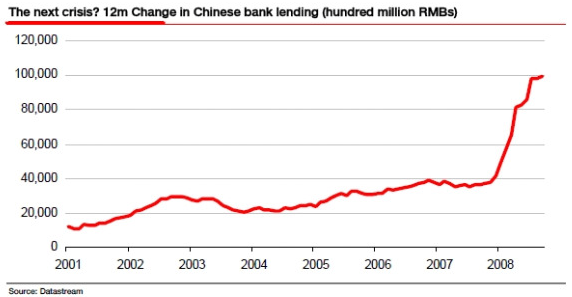
As the following two graphs demonstrate, it’s the major global bank’s that fuelled the sub-prime bubble (in the US) which led to the GFC, and then subsequently it was Chinese stimulus spending and bank lending which helped the world get through the worst of the GFC. China just filled the void to get the world through the first phase of economic depression. This banking bubble is completely unprecedented. There is still many decades of debt still in the system - which is yet to be paid (accounted) for.

Chart 1: Global banking bubble
source: ABC News

Chart 2: Chinese banking bubble... but who will save the Chinese banks!?

The RMB¥ 4 trillion (US$ 586 billion) Chinese economic stimulus plan announced by the Chinese central government was all aimed at getting Chinese companies to build more Chinese goods and buildings. As I will explain a little bit on, China was already building at a very fast and unsustainable rate. This stimulus inevitably brought forward work and is now creating double digit inflation to their economy. Increasing credit always delays and make bubbles worse.

As consumer confidence was low in the US, and China, Japan and Asia were unable to keep exporting products to the US consumer, China took up the slack and increased bank lending dramatically, converting their economy from being strongly export-oriented (to the US) to fuelling domestic demand through stimulus. The Chinese Economic Stimulus Plan was used to offset the sub-prime housing crisis in the US to counter-act it with a Chinese property bubble. In essence, creating a new bubble market to replace a busting bubble market. The end result, I strongly believe, will have dire consequences to China, and Australia and the rest of the world. Like holding out a red flag to a charging bull, China will soon get caught out.

For now the commodity boom will continue, but… the next 10 years will be characterised by extreme volatile periods of double digit annual growth to significant periods of price deflation. Ultimately, gold, silver and soft commodities (food) will be sought after on-mass. People will change their spending habits to have economic security.


Construction, construction, construction!

Construction now makes up 60% of China's GDP. This compares to single digit GDP for China's total exports. China is building and manufacturing absolutely everything for the world, ten times over (or more?)

James Chanos:
No country has ever had done more than 9 years above 33% of GDP (in fixed assets – construction). China is now on its 12th or 13th year.


You gotta be in property! (especially if you are a central government)

In August this year the Financial Review ran an interesting article (lost on page 60) on China's central government trying to cool its property bubble. The article reported that all sorts of random companies were delving into property, from salt companies to railway companies. It goes on...
All around the nation, giant state-owned oil, chemical, military, telecom and high groups are bidding up prices on sprawling plots of land for big real estate projects unrelated to their core business. ...

By driving up property prices, the state-owned companies are working at cross-purposes to the central government's efforts to keep China's real estate boom from becoming a debt-driven speculative bubble.

Records show 82 per cent of land auctions in Beijing this year were won by big state-owned companies outbidding private developers - from 59 per cent in 2008.

Further:
land prices in Beijing had lept 750 per cent since 2003, and that half of tha gain had come in the past two years. Housing prices have also sky-rocketed, doubling in many cities over the past few years.

And as the prices of new apartments soar - in Shanghai, for instance, they often exceed $US 200,000, while the average disposable income isa bout $US 4,000 a year.

The article also made reference to the status of the state-owned banks. They they:
- had made $US 1.4 trillion in loans, nearly twice as much as the year before
- were making off-balance sheet manoeuvres
- were likely sitting on enormous unreported debt

Lastly, the article argues that different levels of government were behind the push in real estate because it was so "incredibly lucrative". Many municipalities have formed local investment vehicles that borrow from state-owned banks to pay to relocate citizens to build on their land, so the government can then auction off the new properties for profit.

Does this all sound like Sub Prime Mortgages on steroids times by a factor of 10?

Housing Affordability in China
One clear clue (regarding the rising real estate prices in China) is that the average price-to-income ratio in Beijing has reached 27:1, five times the world average, according to data from the Bureau of Statistics of the Beijing Municipality. In addition, the average price-to-rent ratio neared 500:1 in the city, far above the international alarm threshold of 300:1, which sends out a clear signal that the foundation of the real estate boom is losing stability.


Steel production up 6 fold in 10 years

To further put this into perspective, all this construction material had to come from somewhere. Of course, in Australia we know about the China boom and our record iron ore and coking coal sales have led to our highest terms of trade since the early 1950s.

Australia has helped fuel the great Chinese construction bubble. In 1999, the Chinese steel industry produced some 124 million tonnes of crude steel. This was a similar size to Japan and the United States. For comparison, in the same year Australia produced about 8 million tonnes. The following two charts illustrate the magnitude of China's construction mania.

Chart 3: China produced 16% of total world steel in 1999
source: World Steel Assoc. (public data)

Chart 4: 10 years later China now produces more than 46% of total world steel output
source: World Steel Assoc. (public data)

China’s steel production has gone up almost 6 fold in the last decade. To put this in perspective Australia’s steel production is now about 1% of China’s (or 0.5% of world) total annual steel production. ie. China produces Australia’s total annual steel production in just 5 days! China is now making more steel than what the entire world produced in around 1990.

To analyse this from another perspective, there are more stories in the media in recent years of ghost cities and empty mega malls springing up in parts of China.

Video: Fuelling the next housing crisis – this time in China

China also has the world’s largest shopping mall, the New South China Mall (based on leasable area) remains 99% vacant since opening in 2005. (video now unavailable)


Centrally planned economies do not work

Centrally planned economies have never worked over the longer term. I am not debating the nitty gritty of what the difference between communism vs. capitalism is, at the end of the day, the more intervention by Government’s and, particularly, central banks, the more mis-allocation of labour and capital there will be. The end result is massive overcapacity and ultimately price suppression (monopolistic behaviour on other countries). China is an extreme case at point, where the central government right down to municipal governments have had competing interests to increase employment at all costs. The municipal/provincial governments have also been competing for trophy industries, they all want to be the biggest and best at manufacturing, particularly steel and automobile industries. Exponential growth in credit, employment, and government intervention in markets eventually comes to an abrupt halt.

Far from what many economic commentators in Australia preach day in day out, that China is Australia’s economic savour amongst the global uncertainty in Europe and the US. To the contrary, I believe our over-reliance on China will ultimately bring harsh repercussions for Australia. On one side, China and the US will kill off the commodity boom. The biggest mining boom in history, inevitably will end in the biggest mining bust. The expansion plans of BHP Billiton, Rio Tinto, Fortescue Metals (among others) will result in major overcapacity, and empty ports. A huge call, perhaps crazy in today's climate, but this endless expansion will not keep going. Many of the major projects will be mothballed. Marginal projects will once again be marginal and left on ice for easy money to come around again.

James Chanos sums up the current situation rather nicely. James is best known for seeing the problems of Enron and shorting its stock up until its collapse. He recently warned that China's hyper-stimulated economy is headed for a crash, led by its housing bubble.
Its become very apparent... that China has embraced capitalism to keep the socialist elites entrenched, while more lately in the West we have embraced socialism to keep the capitalist elites entrenched. It’s a little bit of the opposite side of the same coin.

** Note ** I am soon to launch a new website at www.scottreeve.com, which will incorporate this blog and other areas of interest ~ Cheers, Scott