Showing posts with label gold. Show all posts

Wednesday, September 28, 2011

World markets are discounting that something big will happen

===================
For my latest musings - please visit www.scottreeve.com
===================


This is my take on the world economy - Preserve your wealth while you still can!

The current talk is that the US and Europe may go back into recession. The reality is that they never left recession that hit in 2008. Bogus diluted statistics, such as inflation, unemployment rates have falsely portrayed the economic reality being felt by individuals in towns and cities around the world. Arguably many cities have been in depression for the last decade (look at Detroit and parts of Europe). The world economy is now on a detox diet and it will take many years, if not decades, to clean it up.

The markets are currently discounting that something very, very big is soon to happen. The markets always do this long before the average man on the street and the media realise it.

It could be a combination of things:
*country default;
* Euro monetary changes (Greece is insolvent, and other countries are close behind);
* central bank quantitative easing (monetising debt);
* major bank failure (particularly in Europe); and
* a significant slowdown in China.

All of these things are very real and we are already seeing the effects of this on world markets.


European contagion

All the major Euro countries are so intertwined lending billions to each other. A contagion will quickly spread when more of the bad debts rise to the surface.

Most of the current Euro-cris discussion is centred around Greece. By many measures its economy looks quite sick. It's sharemarket is now at its lowest level in 18 years (This is debt implosion!).

On other measures it certainly doesn't look as bad as other countries. Greece doesn't have the largest amount of government or private debts in the world, or the highest debt-to-GDP. One big difference is that it owes a much higher per cent of its debt to foreign creditors (foreign banks and countries).

Many argue that its non-sovereign entities which are clamping down on Greece. ie. the Global banking cartel led by the IMF, the World Bank, the Federal Reserve etc working in tune with the credit rating agencies (Moodys, S&P, Fitch). All I ask is what is the interests of the global banking groups? All actions to date show that they put their interests and survival ahead of everyone else. They do not care about the sovereignty of nation states.

So which countries banks' have the most at stake with Greece?

The following interactive chart I put together uses Bank for International Settlements data demonstrating which countries banks are most exposed to sovereign Greek debt as of the first quarter ending March 31 2011.

The most exposured banks are (by country):
French banks US$56.9 bn;
German banks US$23.8 bn;
UK banks US$14.7 bn;

The most exposed individual banks are:
BNP Paribas with US$7.1 bn (France)
Dexia with US$4.8 (Belgium)
Société Généralewith US$3.8 (France)

This is just the banks. When you add Government's holding Greek debt the amount is another US$145 bn.

Chart : There has been a huge widening of bony yield spreads and risk insurance on credit default swaps. Greece has gone parabolic. Portugal and Ireland are where Greece was a year ago.

or as Alan Kohler puts it, when the financial crisis hit last time in 2008, it was about liquidity (banks wouldn't lend to one another). This time around its about insolvency. There is plenty of cash around, but the banks might be broke.

Chart:
source: Alan Kohler, ABC News, Sept 2011

The dominoes are lined up

The next graph shows why the banking system is trying to fix Greece before it sets a precedent. You may have heard that Spain and Italy are "too big to fail, too big to bail". Europe bank exposure to Spain and Italy's are 6 to 7 times worse than Greece.

Chart :

The harsh reality is that no industry should be bailed out, including the banks from country to country. The ongoing debt crisis has come about because banks have lended and taken billion dollar bets to keep this unsound monetary system going (which is based on nothing but paper money generated out of nothing).

Monetary systems do blow up - why is the Euro any different?

One article I came across discuses that country default is more common than we are led to believe. There were a number of large defaults in the 1980s and 1990s in emerging countries across the Americas and eastern Europe. Economist Carmen Reinhart states that the list of deadbeat countries included
"current investor favorites like Brazil, which defaulted in 1983, went through a bout of hyperinflation in 1990 and effectively defaulted again, for the same reason, in 2000"

Reinhart and Professor Rogoff show that, on average, nations add 86% to their debt loads within three years of a credit crisis. At the same time, government revenue falls an average of 2% in the second year after the onset of the troubles. The way things are heading Greece and other Euro countries are heading down this path. Debts need to be rolled over...just like...a few snow flakes can lead to an avalanche.

The Stumble Cycle

Sovereign defaults--when a country stops paying its bills--go in waves, often following global financial crises, wars or the boom-bust cycles of commodities. Some countries, like Spain and Austria, mend their ways; others, like Argentina, are repeat offenders.

Chart :

The combination can be fatal for investors holding bonds issued by financially shaky countries like Argentina or Greece, which sell a lot of their debt outside their own borders (as does the U.S.--45% of all publicly held debt). As a nation's finances deteriorate, foreign investors sell their bonds, putting upward pressure on interest rates. That usually sets off a spiral including a deteriorating currency, which, if the bonds are denominated in foreign currencies, makes it impossible for the country to pay its debt. Greece doesn't have to worry about this last syndrome, because it uses the euro. But that might make things worse since it can't print its way out of its financial difficulties. "It's like entering a prize fight with one hand tied behind your back," Bass says. Argentina takes a different tack. Still struggling in the wake of its 2002 default on foreign-held debt, its president recently tried, and failed, to seize central-bank dollar deposits (and cashier her central banker) in order to repay overseas debt.


France

Following from earlier discussion, the big questions are which of the big European banks will go under first. The largest French banks, Credit Agricole and Societe Generale have billions in exposure to Greece and other Euro countries.

Chart : The share prices of the 3 largest French banks have fallen 73%, 87% and 87% since start the debt crisis started in 2008.


Italy

Until recently UniCredit was the largest bank in Italy by market capitalisation and a major euro-zone bank. It owns other large banks in Germany, Austria, and Poland with around 40 million customers all up. As the following charts shows, the market is dumping the two largest Italian banks. UniCredit is one of the "too big to fail and bail" euro banks and many of its depositors lie outside Italy, making and bail out practically impossible.

An ironic twist to this is that, UniCredit's predecessor was a bank called
Credit-Anstalt. This bank collapsed in 1931 which lead to a contagion which took Europe off the gold standard and pro-longed the Great Depression. Few people remain from the last depression era. Perhaps the money lessons need to be relearn?

Chart :


Australian dollar

The Australian dollar is a proxy for commodity prices and ultimately China. The Australian dollar has recently fallen sharply to 97 cents and has hit a major support level. If this fails there is another major support level at 94 cents.

Chart: The Australian dollar managed to bounce off the firs support level at US$0.97


Commodities

Overall commodity prices are not showing that China is in immediate trouble. Base metals: copper, zinc, nickel, lead etc are not in a major bear market yet. This may mean that the current correction will be short lived. If base metals start free falling and other negative signs come from China (popping of housing bubble?), than the Australian dollar and commodity prices will fall a lot (a huge amount) further.

Gold

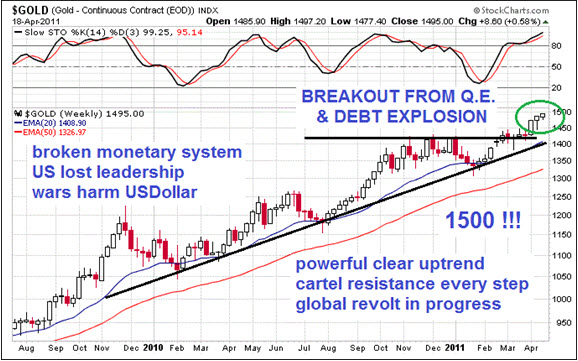
Meanwhile, gold and silver have recently experienced a significant correction. Chart wise (USD/gold), gold's correction is not unhealthy. Gold was sitting at 11 year bull-market resistance line and its trending support line is about US$1550.

Chart:


As I posted recently, I believe the gold demand is getting stronger, and will remain strong, despite the recent price volatility. Since that post it has been reported that Mexico, Russia, South Korea and Thailand have all made large purchases in 2011 and globally, central banks are set to buy more gold this year than at any time since the collapse of the Bretton Woods system 40 years ago. The IMF even reported that European Central banks have started accumulating small quantities of gold after selling on average 400 tonnes of gold a year since 1999.

Silver

Silver plummeted last week by 34 per cent within trading days. It went straight through two key support levels and bounced back above them. After hitting a low of US$26.03, silver rebounded 28 per cent in 28 hours.

Chart: Silver fell 34 percent within 4 trading days, then bounced 28 percent within 28 hours


Is this volatility unusual? Silver is a very small market and historically has been prone to major corrections. My research shows that the major corrections in the last few years has lead to an increase in demand for physical silver (from mints and bullion dealers). I believe this will happen again.

Australia

Take away mining and Australia is in recession, and as I stated early, the key to the Australian economy is whether China can keep its economy upright. If it shows signs of weakness, commodity prices will collapse (along with oil, gold and silver) and the Australian Dollar will fall 10 or 20 cents against the USD.

China kept the world economy somewhat afloat during the global financial crisis, and is the sole reason why Australia didn't go and stay into a technical recession. One of the key barometers on the health of China is commodity prices.

Tourism has been in recession for many years now, in part to the high Australian dollar and a tightening of consumer belts.

Manufacturing has largely been in recession for a number of years except for businesses with astute management and niche business models.

Manufacturing insolvencies growing

Despite insolvencies around the world dropping to their lowest levels in nearly four years, Australia is headed in the opposite direction. This year is shaping up to be a record one for business failures on a par with troubled Eurozone countries. The most recent D&B Global Insolvency Index, ranking business failures in more than 30 key economies, found Australia's insolvency rate was on a par with indebted countries such as Italy, Spain and Hungary. Australia recorded a 12.1 per cent increase in business failures in the June quarter compared with falls elsewhere in the world of 5.7 per cent. D&B said its findings tied in with Australian Securities and Investments Commission data which pegged 2011 as a record year for insolvencies.

Business failures in manufacturing have soared 60 per cent in three years. Almost 300 manufacturing firms went broke in the first six months of this year, the business analyst Dun & Bradstreet says, and just 14 new manufacturers started up. By contrast, in 2008, 974 new manufacturers got off the ground, and only 392 folded.

Retail

Retail is finally entering recession. This has long been coming, even though the likes of Westfield (and other groups) have been creating mega-shopping centres around Australia. The whole retail industry relies on ever increasing amounts of debt (more credit cards and increasing consumption). This model is dead, and there is currently too much competition in Australia alone (before you look at internet shopping of overseas products on eBay and the like). Take electronics, there are so many major stores competing on price, and margins are getting thinner. Many of the private equity firms which bought up a lot of the retailers in recent years have failed, as over-inflated sales targets have missed the mark. In the last 12 months several major groups have entered administration: REDGroup (Borders/Angus and Robertson bookstores); Colorado Group (Jag, and shoe shops), Allied Brands (Baskin Robbins, Cookie Man), Krispy Kreme doughnuts, and Starbucks Australia. Most recently sharper falls in consumer spending has forced Harvey Normany to scrap its Clive Peeters and Rick Hart brands (7 stores to close) and David Jones announcing a 10.3% drop in fourth quarter sales and now expects a small profit for the new financial year.

Sizeable retrenchments are coming.


Housing

Chart:


Lastly, this is a very good presentation by Mike Maloney


Cheers
~ Scott

Tuesday, July 12, 2011

Major developments in the gold market

Precious metals demand is soaring worldwide, as the global debt crisis continues…

Timeline of articles below:
=============================
4 May 2011 – Mexican central bank buys 100 tonnes of gold
20 May 2011 - China becomes world largest gold investment market
6 June 2011 – The Federal Reserve admits it does not own any gold
16 June 2011 – Congressman Ron Paul calls for audit of Fort Knox gold
18 June 2011 - Russia warns it will continue to sell US debt
20 June 2011 - India’s May 2011 precious metal imports up 222 per cent on May 2010
20 June 2011 – China’s central bank to mint more gold and silver coins
22 June 2011 - Greek savers rush for gold
7 July 2011 - Swiss Parliament to discuss gold franc
=============================

plus:
Dow-gold ratio, US home-gold ratio, and interesting videos later in this post.


4 May 2011 – Mexican central bank buys 100 tonnes of gold

FT.com reports:
Mexico has quietly purchased nearly 100 tonnes of gold bullion, as central banks embark on their biggest bullion buying spree in 40 years.
The purchase, reported in monthly data published by Mexico’s central bank, is the latest in a series of large gold buys by emerging market economies intent on diversifying reserves away from the faltering US dollar.
China, Russia and India have acquired large amounts of gold in recent years, while Thailand, Sri Lanka and Bolivia have made smaller purchases.
Central banks became net buyers of gold last year after two decades of heavy selling.
As a result of Mexico’s purchase, central banks, sovereign wealth funds and other so-called “official sector” buyers are on track to record their largest collective purchase of gold since the collapse of the Bretton Woods system, which pegged the value of the dollar to gold, in 1971.
Mexico bought 93.3 tonnes of gold in February and March, according to the central bank, in a haul valued at $4.5bn at current prices and equivalent to 3.5 per cent of annual mined output.

20 May 2011 - China becomes world largest gold investment market

In 2007, China overtook South Africa to become the world’s largest gold mining nation, however it continued to lag India in overall gold demand. Despite producing 351 metric tons of gold in 2010, China’s gold demand last year hit 700 tons.

On 20 May 2011, the World Gold Council said in a quarterly report that Chinese buyers overtook Indians as the world’s largest purchasers of gold for the first three months of this year.

China's investment demand for gold more than doubled to 90.9 metric tons (mt) in the first three months of the year, outpacing India's modest rise to 85.6 metric tons. China now accounts for 25% of gold investment demand, compared with India's 23%.
The report underscores the rising appetite for gold among the growing middle-class in China. Fears of the country's soaring inflation, as well as a search for new investments, is luring investors to gold, and marketing of the precious metal has also increased in recent months.
Historically, India has been the largest investment market for gold. In 2007, just before investing in gold began to take off globally, India's physical gold demand accounted for 61% of the world's total. China's was 9%. In terms of total consumer demand, which also included jewelry, India is still a bigger consumer of gold than China, taking in 291.8 tons in the first quarter, compared with China's 233.8 tons.
Aside from having more money, Chinese investors are also focused on using gold as a protection against rising consumer prices. Unlike paper currencies, gold retains its value when prices increase. That has prompted many Chinese investors to flock to the precious metal.
Gold also is favored by savvy investors as an alternative investment vehicle to assets like shares and real estate. Chinese stock markets have been a disappointment recently, and the government has pledged to clamp down on housing speculation.
The report covers only private-sector demand, but one wild card for the world's gold market is how much gold China as been adding to its foreign reserves. Governments tend to announce their purchases after they buy.

To put this into another angle...

The not realised important fact that the people of China were banned from owning gold bullion from 1950 to 2003, means that the per capita consumption of over 1.3 billion people is rising from a tiny base.


6 June 2011 – The Federal Reserve admits it does not own any gold

Goldsilver.com reports

Video:


Thats right. The Fed owns NO gold. Zero, zip, ziltch.
For those of you who did not watch yesterday’s monetary policy hearing in the house of representatives, you most likely missed this bombshell exchange between Federal Reserve lawyer Scott Alvarez and committee chairman Dr. Ron Paul. My jaw literally dropped when I heard the Fed’s general counsel declare that the Federal Reserve owns no gold. After 1934, Alvarez explains that the Fed handed its gold over to the Treasury in exchange for gold certificates. When pressed further, Alvarez noted that the gold certificates do not represent any interest whatsoever in the gold itself. He explained the gold certificate listings on the Fed balance sheet, not as a claim to gold, but at most a claim to dollars from the Treasury. See the quotes here (and watch the videos at the bottom of the post):
Scott Alvarez: “The Federal Reserve does not own any gold at all… we have not owned gold since 1934, um, so we have not engaged in any gold swap. Before 1934 the Federal Reserve did, we did own gold. We turned that over by law to the Treasury and received in return for that gold certificates.”
Ron Paul: “…You have the securities for essentially all the gold?”

Scott Alvarez: “No. No we have no interest in the gold that is owned by the Treasury. We have simply an accounting document that is called gold certificates that represents the value at a statutory rate that we gave to the Treasury in 1934″

In any case, we can analyze the implications of the basic facts and come to a couple of conclusions:
1) The widespread notion that the Fed owns gold is false. The corollary to this is the mistaken belief that the Fed understates its gold holdings on its balance sheet by only reporting certificates based on the $42.22 statutory gold value. The Fed does not in fact own the US gold stock multiplied by the market price of gold, unless the Treasury defaults and even then its not clear. The Fed does, however, own a claim to currency totaling $11.1 billion and this value has a remote chance of going up significantly if the Treasury revalues its gold and maintains the practice initiated in the Par Value Modification Act.

2) The fact that the Fed owns no gold, nor claims to any gold, means the fundamental value of the dollar lacks any backing besides dollars themselves, not including Fed building and equipment. Dollars are in essence worth a lot less than many people thought, and the Fed is much more impotent in using the prowess of their assets, and conducting monetary policy in general, than many believed. In all, Alvarez’s clarification strengthens the case for gold’s high dollar value immensely.


16 June 2011 – Congressman Ron Paul calls for audit of Fort Knox gold

Businessweek.com reports
Ron Paul, the quixotic congressman and three-time Presidential candidate, has won a following among libertarians and government skeptics for his campaign to abolish the Federal Reserve. Now the Texas Republican has embarked on a new monetary mission: He wants to throw open the doors to Fort Knox.
Paul isn't so sure the nation's supply of gold is all accounted for and thinks it might not exist at all. He has introduced legislation that would require an independent count of the 5,000-plus tons of gold bullion that's sacked away in the Kentucky vault, as well as smaller amounts held in government facilities in Denver, West Point, and New York City. Paul also wants a lab to test the bars, to prove it's as pure as the U.S. Treasury Dept. says.
As chairman of a House Financial Services subcommittee that oversees the gold stores, Paul called a hearing on the matter for June 23. One man who's looking forward to refuting the congressman's doubts: the person in Washington who has actually held those gleaming, 27-pound gold bars in his own hands. Eric M. Thorson, the inspector general of the Treasury, is responsible for keeping track of the U.S. Mint's deep storage gold and silver reserves. Last September, he became the first outsider in 37 years to be granted full access to the U.S. Bullion Depository, as Fort Knox is formally known.
Opened in 1937, the vault is encased in 16,000 cubic feet of granite and 4,200 cubic yards of concrete. Until September, even Thorson and his team of auditors had never stood in the presence of all the gold. Their annual reviews mostly consisted of making sure the locked compartments hadn't been opened. At the time, the tamper guards were decidedly 18th century: Each door was secured with special tape and sealing wax. Thorson tried to reassure Paul that the loot is all there.
The congressman's two-page bill, introduced in April, calls on the Treasury to conduct a full audit of the gold. The Government Accountability Office would then review the results. It also orders a full assay of the government's gold reserves. A small portion of each of the approximately 700,000 gold bars would be extracted and tested for purity.


18 June 2011 - After Dumping 30% Of Its Treasury Holdings In Half A Year, Russia warns it will continue to sell US debt
The WSJ reports that "Russia will likely continue lowering its U.S. debt holdings as Washington struggles to contain a budget deficit and bolster a tepid economic recovery, a top aide to President Dmitry Medvedev said Saturday. "The share of our portfolio in U.S. instruments has gone down and probably will go down further," said Arkady Dvorkovich, chief economic aide to the president, told Dow Jones in an interview on the sidelines of the St. Petersburg International Economic Forum."

Russia has now cut 30% of its Treasury holdings in the past 7 months.

Contrast the above chart with the next chart:

The Central Bank of the Russian Federation updated their website showing that during the month of May, Russia purchased 200,000 ounces of gold for their reserves...and currently hold 26.7 million ounces of gold bullion.


20 June 2011 – China’s central bank to mint more gold and silver coins

Mineweb.com reports
According to a report by Chinese news agency Xinhua, China has been sharply increasing its output of gold and silver coins to meet seemingly ever-increasing popular demand for precious metals as people buy to protect against perceived rising inflation. Indeed it has more than doubled the maximum issuance for 2011 for some popular gold coin sizes from its previously announced levels.
China produces gold and silver Panda coins. The Peoples Bank of China (PBOC) has announced that in view of the rising demand for the coins, the number of one ounce gold Pandas will be raised from the previously announced 300,000 units to 500,000 this year. The smaller coins in the series will have their maximum circulation numbers increased from 200,000 coins to 600,000 for each series. This is a huge increase from the previously announced levels for 2011 which in turn were sharply higher than in earlier years.
And showing the big pick up in demand for silver in China, the PBOC says that it is doubling the maximum issuance of one ounce silver Panda coins from 3 million to 6 million. To emphasise this growth in demand the issuance in 2010 was 1.5 million. …
They are technically legal tender in China. The big rises in the maximum issuance for the smaller gold coins and the series of silver Pandas is yet another indication that not only is demand exploding for precious metals among the Chinese growing middle class, but also confirmation that the government is encouraging its citizens to buy precious metals. In itself this helps underpin precious metals prices.


20 June 2011-- India’s May 2011 precious metal imports up 222 per cent on May 2010

zerohedge.com reports
India's heretofore "insatiable" appetite for precious metals will need to find a new adjective to describe it, after it surged by an absolutely unprecedented 500% in May MoM, and 222% compared to May of 2010, touching on a massive $8.96 billion in imports in the past month. Putting this number in perspective the yearly average Indian imports are about $22 billion: in one month the country will have imported about half its average quota for the year! And while inflation may have much to do with it, events like the Sensex flash crash from last night certainly are not helping matters: "The gold story is puzzling" added financial analyst A S Kirolar. "Consumers are shying away from stocks and bonds and heading to safe assets like gold and real estate, but one cannot understand this given the meagre 12% growth in imports of petroleum and oil products." Granted demand is not just at the retail level as ever more institutions are buying up gold: "Analysts maintained that India's central bank, the Reserve Bank of India's decision to grant licenses to seven more banks to import bullion has helped push up demand. Karur Vysya Bank, State Bank of Bikaner and Jaipur, State Bank of Hyderabad, Punjab and Sind Bank, South Indian Bank, State Bank of Mysore and State Bank of Travancore were added to the list. As of the start of 2011, some 30 banks in India have been granted permission to import gold and silver. Jewellers are getting easy supplies which is also helping push up demand. Moreover, the flow of scrap is also expected to fall from a yearly average of 200 tonnes, which could again boost imports, underlining the insatiable appetite of the Indian consumer." Add ongoing Chinese demand for PMs, and one can see why calls for an imminent gold crash absent a global deflationary vortex are largely overblown.


22 June 2011-- Greek savers rush for gold

ft.com reports
Greek citizens are emptying savings accounts and buying gold as they brace themselves for the possibility of a sovereign default and a run on the banks.
Sales of gold coins have soared as savers seek a safer and fungible source of value.
“When the global financial crisis started, our sales of coins to investors overtook bullion for the first time,” said Harry Krinakis, at Sepheriades, a Greek precious metals trader. “Now the sales ratio has reached five to one.”
Monthly bank withdrawals were running at €1.5bn-€2bn (£1.3bn-£1.8bn) in the first quarter. Last year, depositors withdrew €30bn, equivalent to 12.3 per cent of total savings, according to the central bank. Greek deposits worth an estimated €8bn were transferred to banks in Cyprus in 2010. But the flow has dried up this year amid fears that Cypriot banks could suffer contagion.


7 July 2011 - Swiss Parliament to discuss gold franc

marketwatch.com reports
The Swiss Parliament is expected later this year to discuss the creation of a gold franc — a parallel currency to the official Swiss franc, with the fringe initiative likely triggering a broader debate about the role of the precious metal in the Alpine nation.

The initiative is part of “Healthy Currency,” a campaign sponsored by politicians from the right-wing Swiss People’s Party (SVP) — the country’s biggest — that is seeking to capitalize on popular fears about global financial turmoil and inflation to reverse the government’s current policy on gold.

Switzerland, which in 2000 became one of the last countries to decouple its currency from gold, is not the only place to contemplate a change in the precious metal’s role amid controversy over government involvement in the economy. In March, Utah became the first state in the U.S. to legalize gold and silver coins as currency, while similar legislation was considered in Montana, Missouri, Colorado, Idaho and Indiana.


Other Stuff

Dow/Gold Ratio:


Median Single-Family Home (US) Price / Gold Ratio:


Videos:

James Turk of the GoldMoney Foundation speaks about currency devaluation and the rising gold price. How the gold price is rising against all major currencies and monetary policy is political, having abandoned all pretence of seeking monetary stability. He warns of the dangers of a hyperinflationary crisis. James also explains why gold should be considered money and not an investment.
He also talks of the coming dollar collapse and the waterfall decline in the dollar, especially since Ben Bernanke’s words on QE. He talks of different examples of hyperinflation from paper money hyperinflation in Weimar Germany to deposit currency hyperinflation in Argentina. The presentation was held on 29 April 2011 in Munich, Germany.


Even ABC's 7:30 program has realised there is a major gold boom occurring in Australia and abroad with a segment called "The booming price of gold"

And lastly - the DEBT elephant remains...

~ Scott

Thursday, April 21, 2011

50 Factors Launching Gold

The following article is written by Jim Willie and published at Goldseek.com (which I came across on goldsilver.com)

It covers many areas I follow on this blog in a quick snap shot. State and local Government debt problems in the US are getting closer on the horizon. Gold and silver continues to advance against ALL government currencies (including in Australia).

Edification is not the word that comes to mind when observing an interview with Larry Fink of Blackstone this morning on network financial news. It was inspirational if not humorous, and somewhat pathetic. Of course the interviewer treated him like royalty, when just a syndicate captain, a Made Man. As a cog within the US financial hierarchy, he was asked why Gold is approaching record price levels near $1500 per ounce. He gave his best 10-second answer, showing no depth of comprehension but an excellent grip of propaganda laced with simplistic distortion. He said, "GOLD IS RISING FROM ALL THE GLOBAL INSTABILITY, AND NOT FROM INFLATION AT ALL." Sounds good, but it lacks much reflection of the world of reality burdened by complexity and interconnectivity that the enlightened perceive. At least he did not babble about Gold being in an asset bubble. It cannot, since Gold is money. It is curious that all the analysts, bankers, fund managers, corporate chieftains who did not advise on Gold investment over the last ten years are precisely whom the financial network news appeals to for guidance in the current monster Gold bull run. They knew nothing before, and they know nothing now. The major US news networks carry the Obama water while the USCongressional members carry the USBanker robes and show respect with genuflection before the priests. But guys like Fink are their harlot squires. Poor Ben Bernanke, despite his high priest position, does not gather a fraction of respect that Alan Greenspan did even though Alan presided over the collapse. The wild card possibly later this year or 2012 will be a national movement to force mandatory wage gains, and thus avert a national economic collapse. The squeeze is on in a powerful manner to both businesses and households.


ANOTHER STRONG GOLD BREAKOUT

As long as Quantitative Easing programs are in place and actively pursued, Gold & Silver prices will soar. The programs are urged by exploding budget deficits and absent USTBond demand. That translates to a ruined USDollar currency. Gold & Silver respond to the debasement and ruin. Efforts will become ridiculously stretched to save the USDollar, but will fail. QE will go global and secretive, assuring tremendous additional gains in the Gold & Silver price. No effort to liquidate the big USbanks will occur, thus assuring the process will continue until systemic breakdown then failure. The more extraordinary the measures to save the embattled insolvent fraudulent USDollar, the more the Gold & Silver price will soar. It is that simple. Gold & Silver will soar as long as central banks continue to put monetary inflation machinery to work. They are attempting to provide artificial but coordinated USTreasury Bond demand. In the process their efforts will continue to push the cost structure up further. In my view, since the Japan natural disaster hit with financial fallout, the Global QE is very much in effect, but not recognized as a global phenomenon. It pushes up Gold in uniform fashion worldwide.


50 FACTORS POWERING THE GOLD BULL

1) USFed is stuck at 0% for over two years and printing $1.7 trillion in Quantitative Easing, otherwise called monetary hyper inflation. They are not finished destroying both money and capital.

2) USFed tripled its balance sheet, with over half of it bonds of exaggerated value, while it gobbled up toxic mortgage bonds as buyer of last resort. The mortgage bonds have turned worthless. The USFed waits for a housing revival to bail itself out, but it will not arrive.

3) Debt monetization has gone haywire, as over 70% of USTBond sales from the USFed printing press. The QE was urgently needed, since legitimate buyers vanished. Even the primary dealers have been reimbursed in open market operations within a few weeks.

4) PIMCO has shed its entire USTreasury Bond holdings, seeing no value. They joined many foreign creditors in an unannounced buyer boycott in disgusted reaction to QE which is essentially a compulsory unilateral debt writedown.

5) Growing USGovt deficits have run over $1.5 trillion annually, with absent cuts, obscene entitlements, endless war. The prevailing short-term 0% interest rates are out of synch with exploding debt supply and rising price inflation.

6) Unfunded USGovt liabilities total nearly $100 trillion for medicare, social security, pensions, and more. The obligations are never included in the official debt. It represents insult to injury within insolvency.

7) Standard & Poors warned that USGovt could lose AAA rating in lousy credit outlook, one chance in three within the next two years. Ironically, the announcement came on the day when the USGovt exceeded its debt limit. The network news missed it.

8) State & Municipal debt have collapsed, as 41 states have huge shortfalls, and four large states are broken. They might receive a federal bailout. It could be called QE3, maybe QE4.

9) Coordinated USTBond purchases from Japanese sales have relieved the USFed, as other major central banks act as global monetarist agents. The sales by Japan are vast and growing. Witness the last phase in unwind of Yen Carry Trade, where 0% borrowed Japanese money funded the USTreasury Bonds and US Stocks.

10) Quantitative Easing, a catch word for extreme monetary inflation and debt monetization, has become engrained into global central bank policy, soon hidden. It is so controversial and deadly to the global financial structures that it will go hidden, and attempt to avoid the furious anger in feedback by global leaders. This is the most important and powerful of all 50 factors in my view.

11) The FedFunds Rate is stuck near 0%, yet the actual CPI is near 10%, for a real rate of interest of minus 9%. Historically a negative real rate of interest has been the primary fuel for a Gold bull. This time the fuel has been applied for a longer period of time, and a bigger negative real rate than ever.

12) The USGovt claims to have 8000 tons of Gold in reserve, but it is all in Deep Storage, as in unmined ore bodies. The collateral for the USDollar and USTreasury debt is vacant. It is in raw form like in the Rocky Mountain range or Sierra Nevada range.

13) Fast rising food prices, fast rising gasoline prices, and fast rising metals, coffee, sugar, and cotton serve as testament to broad price inflation. So far it has shown up on the cost structure. Either the business sector will vanish from a cost squeeze or pass on higher costs as end product and service price increases.

14) The entire world seeks to protect wealth from the ravages of inflation & the American sponsored QE by buying Gold & Silver. The rest of the world can spot price inflation more effectively than the US population. The United States is subjected to the world's broadest and most pervasive propaganda in the industrialized world.

15) The European sovereign debt breakdown with high bond yields in PIIGS nations points out the broken debt foundation to the monetary system. The solutions like with Greece in May 2010 were a sham, nothing but a bandaid and cup of elixir. Spain is next to experience major shocks that destabilize all of Europe again, this time much bigger than Greece. The Portuguese Govt debt rises toward 10% on the 10-year yield, while the Greek Govt debt has risen to reach 20% on the 2-year yield.

16) Germany is pushing for Southern Europe bank climax in their Euro Central Bank rate hike. Europe will be pushed to crisis this year, orchestrated by the impatient and angry Germans. They have no more appetitive for $300 to $400 billion in annual welfare to the broken nations in Southern Europe.

17) Isolation of the USFed and Bank of England and Bank of Japan has come. The small rate hike by the European Central Bank separated them finally. The Anglos with their Japanese lackeys are the only central banks not raising rates. With isolation comes all the earmarks on the path to the Third World.

18) The shortage of gold is acute, as 51 million gold bars have been sold forward versus the 11 million held by the COMEX in inventory. Be sure that hundreds of millions of nonexistent fractionalized gold ounces are polluting the system. Word is getting out that the COMEX is empty of precious metals.

19) Such extreme Silver shortage has befallen the COMEX that the corrupted metals exchange routinely offers cash settlement in silver with a 25% bonus if a non-disclosure agreement is signed. The practice cannot be kept under wraps, as some hedge funds push for fat returns in under two months holding positions with delivery demanded.

20) China has begun grand initiatives to replace its precious metal stockpiles. They are pursuing the Yuan currency to become a global reserve currency. As they build collateral for the Yuan, they are also elevating Silver as reserves asset.

21) A global shortage of Gold & Silver has been realized in national mint production. From the United States to Canada to Australia to Germany, shortages exist. Many interruptions will continue amidst the shortages, which feed the publicity.

22) The Teddy Roosevelt stockpile of 6 million Silver ounces was depleted in 2003. He saw the strategic importance of Silver for industrial and military applications. The USEconomy and USMilitary will turn into importers on the global market.

23) The betrayal of China by USGovt in Gold & Silver leases is a story coming out slowly. The deal was cut in 1999, associated with Most Favored Nation granted to China. But the Wall Street firms broke the deal, betrayed the Chinese, and angered them into highly motivated action. No longer are the Chinese big steady USTBond buyers, part of the deal also.

24) Every single US financial market has been undermined and corrupted from grotesque intervention, constant props, and fraudulent activity. The degradation has occurred under the watchful eyes of compromised regulators. Fraud like the Flash Crash and NYSE front running by Goldman Sachs is protected by the FBI henchmen.

25) The USEconomy operates on a global credit card, enabling it to live beyond its means. The USGovt exploits the compulsory foreign extension of credit in USTBonds, by virtue of the USDollar acting as global reserve currency. Foreign nations are compelled to participate but that is changing.

26) The USMilitary conducts endless war adventures for syndicate profits. They use the USTreasury Bond as a credit card. The wars cost of $1 billion per day is considered so sacred, that it is off the table in USGovt budget call negotiations, debates, and agreements.

27) Narcotics funds have proliferated under the USMilitary aegis. The vertically integrated narcotics industry is the primary plank of nation building in Afghanistan. The funds keep the big US banks alive from vast money laundering.

28) No big US bank liquidations have occurred, despite their deep insolvency. Any restructure toward recovery would have the liquidations are the first step. The USEconomy is stuck in a deteriorating swamp since the Too Big To Fail mantra prevents the urgent but missing step.

29) The unprosecuted multi-$trillion bond fraud over the last decade has harmed the US image, prestige, and leadership. The main perpetrators are the Wall Street bankers and their lieutenants appointed at Fannie Mae and elsewhere. They bankers most culpable remain in charge at the USDept Treasury and other key supporting posts like the FDIC, SEC, and CFTC.

30) The ugly daughters Fannie Mae and AIG are forever entombed in the USGovt. They operate as black hole expenses whose fraud must be contained. The costs involved are in the $trillions, all hidden from view like the fraud. Fannie Mae remains the main clearinghouse for several $trillion fraud programs still in operation.

31) The US banking system cannot serve as an effective credit engine dispenser, an important function within any modern economy. It is deeply insolvent, and growing more insolvent as the property market sinks lower in valuation. The banks lack reserves, and hide their condition by means of the FASB permission to use fraudulent accounting.

32) The big US banks are beneficiary of continuous secret slush fund support from the USGovt and USFed. Their sources and replenishments have been gradually revealed. The TARP Fund event will go down in modern history as the greatest theft the world has ever seen, easily eclipsing the biggest mortgage bond fraud in history.

33) The insolvent big US banks continue to sit at the USGovt teat. The vast umbilical cord of banker welfare has not gone away. Goldman Sachs still is in control of the funding machinery.

34) The shadow banking system based upon credit derivatives keeps interest rates near 0%. The usury cost of money is artificially low near nothing. As money costs nothing, capital is actively and rapidly destroyed.

35) A vast crime syndicate has taken control of the USGovt. A vast crime syndicate has taken control of the USMilitary. A vast crime syndicate has taken control of the USCongress. A vast crime syndicate has taken control of the US press networks.

36) A chronic decline of the US housing sector keeps the USEconomy in a grand decline with constant deterioration. With one million bank owned homes in inventory, a huge unsold overhang of supply prevents any recovery of housing prices. Home equity continues to drain, and bank balance sheets continue to erode.

37) Over 11 million US homes stand in negative equity. The sum equals to 23.1% of households. They will not participate much in the USEconomy, except when given handouts. They have become downtrodden.

38) The USEconomy will not benefit from a export surge. The US industrial base has no critical mass after 30 years of dispatch to the Pacific Rim & China. The industry must contend with rising costs in offset to the falling USDollar, which is cited as providing the mythical benefit. Then can export in droves if they do so at a loss.

39) A global revolt against the USDollar is in its third years. The global players work to avoid the US$ usage in trade settlement. Several bilateral swap facilities flourish, mostly with China. If China supplies products, then the Yuan currency will be elevated to global reserve currency.

40) Global anger and resentment over three decades has spilled over. The World Bank and IMF have been routinely used by the US bankers to safeguard the USDollar and Anglo banker hegemony. Neither financial agency commands the respect of yesteryear.

41) A middle phase has begun in a powerful Global Paradigm Shift. The transfer moves power East where the wealth engines of industry lie, far from the fraudulent banking centers. The next decade will feature the Chinese as bankers, since their war chest contains over $3 trillion.

42) The crumbling global monetary system was built on toxic sovereign debt. Legal tender has been nothing more than denominated debt posing as legitimate by legal decree. That is what word FIAT means. The system is gradually breaking in an irreversible manner.

43) The global central bank franchise system has been discredited. It is a failure, which is not recognized by the bank leaders still in charge. The stepwise process of ruin continues with a new sector falling every few months. Next might be municipal bonds.

44) Witness the final phase of a systemic cycle, as the monetary system has run its course. It is saturated with debt from faulty design. The deception cited in the mainstream media focuses upon the credit cycle which will renew. It will not. It will break of its own weight and lost confidence.

45) The recognition has grown substantially that suppression of the Gold price has been the anchor holding fiat system together. The Chinese realize that Gold, when removed, leads to the collapse of the US financial system. They realize it more than the US public. But the syndicate in control of the USGovt understands the concept very well, as they designed the system.

46) The institution of a high level global barter system might soon take root. Gold will sit at its central core, providing stability. No deadbeat nations will participate. That includes the United States and several European nations. The barter system will be as effective as elegant.

47) The movements spread like wildfire in several US states to reinstitute gold as money. In a few states, led by Utah and Virginia, progress has been made for Gold to satisfy debts, public & private. Consider the movement to be in parallel to the Tenth Amendment movements.

48) Anglo bankers have lost control in global banking politics. The phased out G-7 Meeting is evidence. China has wrested control of G-20 Meeting, and has dictated much of its agenda in the last few meetings. The US has been reduced to a diminutive Bernanke and Geithner being ignored in the corner.

49) New loud stirrings by Saudi Arabia seek a new security protector. If security is no longer provided by the USMilitary, then the entire defacto Petro-Dollar standard is put at risk. Remove the crude oil sales in USDollars exclusively, and the US sinks into the Third World with a USDollar currency that cannot stand on its own wretched wrecked fundamentals.

50) The IMF solution to use SDR basket as global reserve is a final desperate ploy. By fashioning a basket of major currencies in a basket, they attempt to enforce a price fixing regime. It is a hidden FOREX currency exchange rate price fixing gambit that will invite a Gold price advance in uniform manner across the currencies bound together. This ploy is being planned in order to prevent the USDollar from dying a horrible death at the expense of the other major currencies. By that is meant at the expense of the other major economies which would otherwise have to operate at very high exchange rates.


THE BIGGEST UPCOMING NEW FACTORS

Introduction of a New Nordic Euro currency is near its introduction. The implementation with a Gold component will send Southern European banks into the abyss, marred by default. The new currency has the support from Russia and China, even the Persian Gulf. In my view, it is a USDollar killer. The first nations to institute a new monetary system for banks and commerce will be the survivors. The rest will slide into the darkness of the Third World.

Gold & Silver seem to be the only assets rising in price, an extension of a terrific 2010 decade. The exceptions are farmland and the US Stock market. However, stock valuations are propped by constant and admitted USGovt support. Their efforts are mere attempts to keep pace with the USDollar decline, as stocks merely maintain a constant purchase power.

A hidden overarching hand seeks the global Gold Standard as the bonafide solution. Darwin is at work, but Adam Smith turns a new chapter. The crumbling monetary solution demands a solution. Further investment in the current system assures a devastating decline into the abyss of insolvency and ruin.

Monday, October 5, 2009

Australia – selling our (fake and real) money to the world

Playing with toy money

If a child tried to pay for lollies at a tuck shop with notes from the Monopoly board game, the shop staff would know instantly that it was fake money... Yet in today’s society, we commonly accept and take for granted the polymer banknotes which we use every day as “money”. They are both just pieces of paper, so what’s the difference? They are both forms of currency, but accepted under entirely different circumstances. Paper money today, whether it be Australian Dollars or Zimbabwe Dollars are deemed valuable, only if the population believes it should represent value. We still believe a $50 Australian dollar note is worth $50 dollars – because that’s what the note tells us. However, we are aware that a $50 note today doesn’t buy as much as it did 10 years ago. Despite the knowledge that inflation is eating away at our purchasing power, we continue to be loyal to our currency. One day this will change, and it will be just monetary history repeating .

Fake (Fiat) vs Real Money

Part of the money problem today is that the definition of money has changed over the generations. Few people alive today were alive in the 1920s or 1930s when coins actually had silver in them, where your savings in the bank held its purchasing power, because our money was linked to gold. 100 Years ago, gold and silver were referred to as money, as it was the lifeblood to the monetary system. Today gold and silver are.... gold and silver, and banknotes and circulating coins are referred to as money. Another way to put it, gold and silver has and always will be real money, as it is a finite resource, while banknotes and circulating coins are merely currency. Currency is not money! It’s a fake, and more and more people will realise this over the coming decade as inflation dilutes our currency, while at the same time, increasing the value of real money (gold and silver).

Banknotes used to represent value

Historically banknotes were merely receipts for “real” money, that is, gold and silver. If you deposit 1 ounce of gold, you got a banknote (a receipt) which said it was redeemable for the amount written on it. In the US, its Constitution was written to include , that "No State shall...make any Thing but gold and silver Coin a Tender in Payment of Debts." Therefore, up until 1933, US banknotes held the words “Redeemable in gold on demand at the United States Treasury”. (confirming the role of the banknote as a receipt). In the Australian Constitution, Section 115 establishes the same principle, that “a state shall not coin money, nor make anything but gold or silver coin a legal tender in the payment of debts”.

The Constitution is our legal and political rule book (in this instance in Australia, Section 115 is the rule for monetary policy), but despite this, in 1971 the principle of backing a currency with real money was removed, when President Nixon removed the gold window for US Dollars, thus making the US Dollar and all other currencies in the world completely fiat (money declared by a government to be legal tender). In other words, between 1946 and 1971, any nation could hand in their US Dollars (receipts) and buy gold from the US for US$35 dollars a troy ounce.

Because the US printed extra dollars to pay for a negative trade balance and increasing inflation, other countries (particularly France, Switzerland and Great Britain) began to convert/redeem their US Dollar reserves with US gold. Thus the US had no choice but to abandon the system in order to preserve its gold. However, following this change, the US Dollar remained the world reserve currency, despite there no longer a requirement to link the Dollar to gold. Thus an endless money tree was born – and now around 70 per cent of the world’s currencies are denominated in US Dollars (with half of these Dollars residing outside the US).

Private bankers control our monetary system – not Governments

After explaining this brief history, there is one critical element which has not been covered. Since 1913, the Federal Reserve has been responsible for issuing currency in the United States. The Federal Reserve is a non-Government, private corporation which has private shareholders. It was established by private European bankers from families such as the Rothchilds, and Warburgs. These private banking families still remain shareholders of the US Federal Reserve, and thus have direct control over world monetary policy – through the US Dollar, and through the debt based Fractional Reserve Banking system. If the US Government can issue bonds, why does it need a private banking consortium to issue currency for the people? (I will go into greater depth another time).

Likewise in Australia, Australia’s banknotes and coins are issued in the same was that US Dollars are issued in the United States. For one year in 1910, Australia’s notes and coins (Pounds) were controlled by the people, under the Treasury Department. By 1911, the Commonwealth Bank was given powers to issue banknotes (however this was not made law until 14 December 1920 through the Notes Issue Board), and given central banking powers in 1945. The convertibility of Australian banknotes into gold effectively ended during World War I. In 1959, the central banking powers held by the Commonwealth Bank were transferred to the new Reserve Bank of Australia (RBA). Like the recently created Future Fund, the RBA is not a Government Department, but an independent statutory authority. Essentially the RBA make decisions on monetary policy (how much money (or inflation) to print) – just like the Federal Reserve has the power to influence the US Dollar (and economy through interest rates) in anyway it sees fit.

So why do we have confidence in paper money such as Australian Dollars today? Why do we allow bankers to control our money (by inflating it continually year in year out, largely through fractional reserve banking). Aren’t we just using Monopoly (Central Bank controlled) money?

So now that we know Australia no longer backs its Dollars with gold, what has the RBA done with our gold?

The Australian Government sold "our" gold

In early 1997 the Reserve Bank of Australia held nearly 250 tonnes of gold bullion reserves. By July 1997, the RBA sold 167 tonnes, reducing its holdings from 247 to 80 tonnes (selling some 6 million troy ounces). That 167 tonnes of sold gold is now worth an extra US$4.2 billion more 12 yrs later. What will it be worth in 10 years time? More importantly, what sort of purchasing power will that gold have in 10 years time (remember, there is a huge difference between price and purchasing power!) It’s ok for the RBA to make such a mistake though?

The RBA, the bankers, sold our gold (our money) near the bottom of the commodity cycle so it could leverage its balance sheet to speculate in fake money (currencies).

It’s even in the RBA’s charter that:
'It is the duty of the Reserve Bank Board, within the limits of its powers, to ensure that the monetary and banking policy of the Bank is directed to the greatest advantage of the people of Australia and that the powers of the Bank ... are exercised in such a manner as, in the opinion of the Reserve Bank Board, will best contribute to:
(a) the stability of the currency of Australia;
(b) the maintenance of full employment in Australia; and
(c) the economic prosperity and welfare of the people of Australia.'
I would argue that the RBA, and all other central banks around the world are:

A) Increasing the instability of the currency
B) Creating fake job opportunities through the current monetary system (eg. How many jobs rely on an inflation society – superannation, sharemarket, house prices inflating. ie. Bankers, accountants, lawyers...)
C) Decreasing the economic prosperity and welfare of the people of Australia (through the debt-based fractional reserve banking system to ensure businesses and individual become enslaved to the banks)

Anyway, its ok for Australia, we are naturally endowed in gold. We have enough gold in the ground to replenish and to restore to a more sound monetary system in the future – right? Only if our politicians, and everyone else learn basic monetary history. We are conditioned at school, amongst other things, to be savers, not investors - to rely on debt to buy “assets”. It is not a coincidence Australia is now a consumption/services economy today (and why we are willing to sell our gold dirt cheap).

Taking this one step further, from a different angle, lets examine what Australia, as a country does with its real and fake money. The great paradox is that Australia is well endowed in both real and fake money. We are a major gold producer/exporter (real money) and a significant producer and innovator of banknotes (fiat money).

1. Fiat Money

Note Printing Australia (NPA) - a wholly owned subsidiary of the Reserve Bank of Australia, prints the banknotes for Australia, New Zealand and a handful of other countries. In 2008, it exported 182 million (fiat) banknotes.

Securency International – 50 per cent owned by the Reserve Bank of Australia, prints the polymer substrate for banknotes which is used by 27 countries around the world. In 2008, it supplied polymer substrate to 13 countries. The company now has substrate manufacturing plants in Mexico to supply Latin America.

Both NPA and Securency achieved similar profits in 2008 to 2007.

So it appears Australia has been a world leader in the evolution of currencies, and has done modestly out of exporting banknotes (receipts) and banknote technology.

Let's compare to Australia's recent achievements selling real money.

2. Real Money

Lets now examine Australia’s production and export of real money – specifically gold.
For anyone who may not be aware, Australia and the world is currently experiencing a major bull market in gold and silver. With the explosion of Government and private debt, it is inevitable that more and more people will flock to real money, as opposed to printed money. We are currently halfway through a normal commodities cycle (which started in 1999). I feel this will be no ordinary cycle,but a once in a lifetime opportunity for a large wealth transfer to those who hold real money (particularly silver).

Until more recently, Australia, like South Africa, has had declining gold production for the past couple of decades. China became the world’s largest gold producer in 2007, but Australia should resume number 2 spot in 2009. If we compare the Australian Government’s view of gold to that of China, we get two completely different views. Australia is short-sighted, we see gold as a commodity export earner only, to fuel our consumption/services economy. On the other hand, the Chinese central Government is slowly accumulating gold and is buying most of its domestic production (oddly enough, an Australian company, Sino Gold is China’s largest gold producer). China is about to overtake India as the world’s largest buyer of gold.

Recent trade statistics supports this view. In 2008, Australia exported $14.3 billion worth of gold (up 27% on 2007), of which nearly 40 per cent was exported to India. Australia is also a major importer of gold, importing nearly $9.7 billion (up 59% on 2007), reflecting Australia’s niche capability in refining gold dore’ bars. Most of this gold is then re-exported.

This then leads into: AGR Matthey. This company (40% owned by the Perth Mint) refines about 60 percent of Australia’s annual mined gold. AGR Matthey refines the dore bars into 99.9% gold bars.

Now, the most interesting part of this post.

The Perth Mint - is one of only about six bullion mints in the world (partly owned by WA Govt). It is a top 50 export earner for Australia, with over 90% of its products exported overseas. It is Australia’s largest gold refiner (under the name Gold Corporation) and refines about 60 per cent of Australia’s annual gold production.

The Perth Mint recently released its annual report for 2008-09.

The growth in volume and profit is quite staggering for only one year. The Perth Mint is selling real money to the world, and making very handsome currency profits.

- A ten fold pre-tax profit increase to $38 million (up from original forecast of $4.9 million).
- Sales of coins, bars and medallions up 50 percent to 2.7 million units.

What I find most interesting is the growth in metal volumes. Here are my calculations based on their recent annual reports.

Graph 1:
To me, silver is the clear stand out in growth.

Analysing further:
- Averaging 100% volume growth per annum over the last 5 years.
- The 229 tonnes of silver produced in 2008-09 equates to 7.36 million troy ounces of silver (vs. 4.5 million in 2007-08).
- Excluding the last couple of years of silver product production, 229 tonnes is more than all the Perth Mint silver coin production for a 20 year period from 1987.

Clearly silver is exploding in growth, but only about 1 in 100 people would know this. But why?

Silver's price is biscuits compared to gold, and yet silver is 4 to 5 times rarer in gold today! This is because silver is still heavily manipulated by two US based banks on the NY COMEX exchange. No other investment opportunity I have studied comes close to the potential of silver. This may seem uncharacteristic to overstate such a claim, but do not take my word, study and draw your own conclusions. To determine if gold and silver are going to be good long-term investments will largely depend on your 10-20 year outlook for the world economy and for inflation. It's better to do a bit of study than to put it into the too hard box. I believe big inflation, political and social instability is almost all but inevitable because the current debt-based monetary system is broken. It’s just monetary history repeating. All past fiat currencies have collapsed to their true value - zero. There are times when fiat currencies, and debt are king (post WWII to 1999), and there are periods when real money is king, and is the only form of accepted money (other than barter). Don’t take my word for it. Like any investment, it is important we do our own due diligence. We must embrace individualism and always look outside the box (tv screen).

This post is starting to hit the crux to the reasoning behind why I first set up this blog. Understanding basic monetary history and having an awareness of current monetary events are vital if we are to shed some light on where the world economy is heading to in the next decade.

Best,
Scott

Concluding thought:
A few weeks ago I visited the Perth Mint, and one thing I found most intriguing is that it’s large gold bar collection is owned by N M Rothschild & Sons (of London). The same, famous banking dynasty which set-up the first central bank, the Bank of England, and later the Federal Reserve in the US. More on central banking soon...

Thursday, June 18, 2009

The Houdini Economy

I believe there are many, many parallels in the world economy today, to that of previous economic depressions. We need only to look at past history. However, historian's all have different accounts and points of view. Is historical information based on objective analysis, primary evidence or a biased second hand account?

Is the economic events of today so different to that of the past? We are constantly told we are living through the worst economic downturn since the Great Depression; then we are told Australia has a resilient economy and that we are weathering the storm. Surely it can't happen to us?

"But we live in a modern, innovative, high-tech society today!"

In the 1920s America - the "Roaring Twenties", the sharemarket was booming, the humble car was built for the masses (T-Model Fords), and the population was extremely opportunistic. The population had never felt so wealthy, the horse and buggy were essentially gone from urban areas and the economy had never been more innovative. It seemed the good times would always last.

And today? We live in the so-called "new economy". A modern, innovative, high tech economy. We have never felt wealthier. We expect the good times to always get better. The next 20 years will be better then the last 20 years.

These are two different points in history - but the same human traits of economic complacency are well and truly alive today. There is usually a large economic depression every 75 years - the average life span of a human. Is it a coincidence economic lessons repeat? Is it a coincidence that each generation since the 'silent' generation (of the 1920s and 30s) has progressively had worse money habits than their parents generation? Everything used to be bought within our means, today its on credit, and we have little incentive to save for a raining day.

Houdini economy

** The big difference between 1929 and today, I believe, is the acceptance of mis-information by the general public and an acceptance to think the monetary system will always work. We live in the so called "Information Age", yet our diluted statistics mean we live in a Houdini economy. It's all smoke and mirrors. Government's have an interest to keeping the public unaware about what is really happening in the economy - to maintain political and social stability (in the short run).

However, comparing today to the past has become distorted because economists, Governments, and the media think they are comparing apples to apples. Today, statistics are treated as gospel. We believe that the stats on the nightly news are accurate, objective and unbiased. Why are we not learning from recent events? Many of the economists and bankers who got it wrong, are still in positions of power and influence. Central banks are being given expanded powers (particularly the Fed Reserve), rather than face increased accountability.

More often than not, an economic number today will be grossly diluted to that of 75 years ago. For example, the unemployment rate, or level of inflation are grossly misunderstated today.

For instance why is unemployment so low at the moment? In the 1930s it got to 32 per cent in Australia! Yet it is still around 5 per cent today, despite a recession and economic turmoil worldwide.

Answer: The ABS counts people as been employed if they are working just 1 hour per week.

But as the following chart shows, the number of hours worked has been falling gradually in the last 15 years. For starters there are a lot more part time jobs. It's good for people who want to work less, but its bad for recording what the real unemployment rate should be.

Chart 1:
Source: Kohler, ABC News

Getting back on topic - lets compare further to the last Great Depression:

1929 to 1932- the greatest sharemarket crash in history put the world into a Great Depression. In 3 years the market fell 89 per cent.

Current sharemarket crash? Depends on your measuring stick, namely, the monetary system has changed. 1929 money was backed by gold. Today it is backed by an exponential curve of debt.

If we use the Dow/Gold Ratio (which is what the 1929 sharemarket crash was recorded against), then the current bear market we have today really started in 1999 (not 2007). So far from top to bottom of the bear market the Dow Jones has fallen 84 percent measured against gold (the old monetary unit).

Perhaps we are already in economic depression but we just aren't awake to it?

As the following chart shows, the inflated US Dollars of today have diluted the impact of what is really happening. From 1999 to 2007 the Dow Jones rose in nominal terms, while the old monetary system was showing the economy was sick (and crashing), now both these measuring sticks are showing the US and world economy is continuing to tank.

Chart 2: Dow Jones over last 100 years
Wow - look at the 1929 crash! It's huge. What this chart fails to show is that important change of the monetary rule book in 1971 (when the gold link was removed).

The following chart puts the 1929 crash, and today's sharemarket crash into a better perspective (apples vs apples).

Chart 3: 100 yeas Dow/Gold Ratio.
Source: Steve Hickel, gold-eagle.com

The last dip in Dow/Gold Ratio:

Notice has taken at least 32 years to reach a new peak in the Dow/Gold Ratio in the last two downturns. In the last downturn there was stagflation in the 1970s, a change of the monetary rulebook in 1971, a commodity price peak in 1982, and an increase in social security outlays of Governments among other things. There was no great depression, but inflation was accepted and new bubbles came along to occupy everyone's money. The key last time is that there remained confidence in the new fiat monetary system. I believe this time round will be different.

Clearly there is a huge difference between Chart 2 and Chart 3. Chart 2 is an inflation drive chart. Chart 2 characters a true free market which goes from undervalued to overvalued and back over time. (Change the monetary system (methodology), and you will change the shapes of the charts!)

Steel industry today vs 1920s

Lets compare 1920s and today even further...

In the 1920s, there was a huge boom in the United States steel industry. 15 per cent of steel was used in automotive manufacturing. By 1928 there was over 21 million cars, enough for 1 in every 6 Americans. When the Great Depression hit however, by the mid 1930s over 50 per cent of the United States steel capacity stood idle.

Today there is vast amounts of steel capacity standing idle also. Lets compare.

Kingdom of Rust

According to latest research from Macquarie Bank, there is some 362 million tonnes per annum of unutilised steel capacity in the world.

Chart 3: Today, around 25 per cent of the world's steel capacity is sitting idle.
Source: Macarthur Coal Presentation - 17 June 2009

To put this into perspective, this is equivalent to:
- every single steel mill in Europe, Japan and Korea shutting down OR/
- ¾ of China’s steel production closing down.

With all this recent iron ore hype in the Australian sharemarket (in the last couple of months), just stop for one moment and envisage 3 out of every 4 steel mills in China closing down. Only the lowest cost (lowest debt) iron ore, coking coal, steel producers could survive a sustained turn down. Clearly there is too much capacity worldwide. This is not unique to just the steel/iron ore industries. The capacity for most goods today is built on the premise that the current monetary system will continue to work, that the world economy will continue to expand at a rapid rate, and that our tolerance of debt will continue to expand.

All this extra capacity will have to be removed from the system. Many companies will continue to go under. This is only natural. In the boom times too much competition led to cheaper cars and airfares, and even steel was pre-fabricated in China and exported back to Australia! There needs to be a giant shake-out across industry worldwide. Give it a few years..

Baltic Dry Index

Much of the gains on the Australian Securities Exchange (ASX) in recent months have been on the back of a bounce in commodity prices (ie. A fall in the US Dollar), and increased shipping movements out of China for Australian iron ore and coal. This has also lifted the Baltic Dry Index (BDI), which had a major crash in 2008. The BDI is a daily number published by the Baltic Exchange – it tracks world wide international shipping prices for dry bulk cargoes such as iron ore. It shot up in the boom years, and crashed big time last year as the following chart demonstrates.

Chart 4: Baltic Dry Index crashed 94 percent when the resources boom bust, its now rebounded on growing Chinese iron stockpiles.
Source: Bloomberg

The following chart from Alan Kohler pictures an interesting relationship between the BDI and movements in the Australian and US Dollar. Positive movements in commodity prices (particular in US terms) and the BDI - is a positive force for the Australian sharemarket.

Chart 5: Baltic vs AUD
Source: Kohler, ABC News

I believe its now time for the BDI to fall sharply once again. The third quarter of the calendar year is traditionally the worse for commodity prices (from my experience, particularly in base metals). Apparently about 10 per cent of the world Capesize ships (the largest) are sitting of Chinese ports, unable to unload their iron ore. The two largest iron ore terminals in China are said to be close to full capacity. Now that the 2009/10 iron ore benchmark prices have been finalised (with Japan and Korea), my bet is the Chinese have done most of their shopping for this year, and will try to manipulate the market in the short-run to really hammer down prices come next year.

World Trade

Ok, so i've talked about the BDI - what about world trade as a whole?

The following chart from Alan Kohler paints a bleak picture for world trade. It uses a base of 100 for the peak in world trade (some 12 months ago). Already we have gone from a massive boom, and the big bust continues at a greater magnitude than the 1929 trade bust. Just like the 1920s America – there is significant overcapacity in the world. Trade flows are stalling.

Chart 6: World trade has fallen off a cliff much higher then the Great Depression slump.Source: Kohler, ABC News

Covering up debt - back to the suitcase method

We all know what hiding bad debts can do... Subprime mortgage-backed securities, bundled together, given a AAA rating and sold overseas to unknowing investors worldwide. This grand scheme worked for a while... now it appears the humble suitcase is back in vogue to move Government debt around.

Here is a rather amusing article. If this were true... the US/Japanese Governments are running out of places to hide their debt!!

Suitcase With $134 Billion Puts Dollar on Edge
Two Japanese men are detained in Italy after allegedly attempting to take $134 billion worth of U.S. bonds over the border into Switzerland. ..

The trillions of dollars of debt the U.S. will issue in the next couple of years needs buyers. Attracting them will require making sure that existing ones aren’t losing faith in the U.S.’s ability to control the dollar. ..

Think about it: These two guys were carrying the gross domestic product of New Zealand or enough for three Beijing Olympics. If economies were for sale, the men could buy Slovakia and Croatia and have plenty left over for Mongolia or Cambodia. ..

Let’s assume for a moment that these U.S. bonds are real. That would make a mockery of Japanese Finance Minister Kaoru Yosano’s “absolutely unshakable” confidence in the credibility of the U.S. dollar. ..
Bad news can only be covered up for so long. Question everything!

Scott